
Rajabhakti Park: Visiting Hua Hin's Seven Kings Monument

Rajabhakti Park needs about one to two hours, and it is less a temple than a military-built memorial ground: seven towering bronze kings lined up on a raised terrace above a vast ceremonial plaza. The park sits in Nong Kae on Phet Kasem Road, south of central Hua Hin, and it rewards readers who know which king is which before they arrive. This guide covers the layout, the statues in order, how to get there, and how to slot the visit into a southern Hua Hin run.
What Rajabhakti Park actually is
Rajabhakti Park, written in Thai as อุทยานราชภักดิ์, is a historically themed park honoring past Thai kings from the Sukhothai period through the current Chakri house. It was built by the Royal Thai Army on army property, with funding from public and private donors, and King Bhumibol Adulyadej gave the site its name, which is usually translated as the park built with people's loyalty to the monarchs.
That origin matters for expectations. You are walking into a formal memorial ground managed by the army rather than a working temple, so the atmosphere is open, ceremonial and photogenic rather than incense-heavy. There is no ordination hall to tiptoe around, but the scale and symmetry are the point: this is a place to read inscriptions, look up at faces, and cross a lot of paving.
Treat it as a focused stop rather than a half-day attraction. If you are weighing how to spend a Hua Hin day, the park works best as one component of a route south of the center, not as the reason for the trip on its own.
Where it sits in Nong Kae, south of town
The address is on Phet Kasem Road in Nong Kae, Hua Hin District, Prachuap Khiri Khan 77110 — the same long highway that carries traffic south toward Khao Takiab. In practical terms, you are heading away from the clock tower and Night Market end of town, so budget real travel time rather than assuming a short stroll from a central hotel.
The site is laid out in three main parts: the seven great kings monuments on a roughly five-rai platform, a ceremonial plaza of about 91 rai used for events, and a museum building at the base of the monument. The remaining land is park and recreation space, and the whole site covers around 222 rai.
Knowing that structure helps you navigate. Arrive, cross the plaza, climb to the statues, then drop into the museum at the base before leaving, rather than wandering without a sequence and doubling back across the sun.
Getting there from Hua Hin town
There is no dedicated rail or boat link to the park, so the realistic options are songthaew, tuk-tuk, a Grab car or a rented scooter along Phet Kasem Road. If you are coming from the Hua Hin railway station area, expect a road journey south through town traffic rather than a walkable connection; confirm the fare with the driver before setting off, since no published rate is available to quote here.
A scooter gives you the most flexibility, because the park's entrance sits off a highway where you will want to lock up and walk in. Ride-hailing apps work in Hua Hin, but pickup spots on Phet Kasem Road can be awkward at busy times, so agree on the exact gate or forecourt where your driver should meet you.
If you are pairing the park with a beach stop, Khao Takiab is the logical southern anchor, and the two combine naturally on one loop along Phet Kasem Road. Allow extra time in the late afternoon, when southbound traffic thickens and the plaza offers little shade.
The Seven Kings Monument, left to right
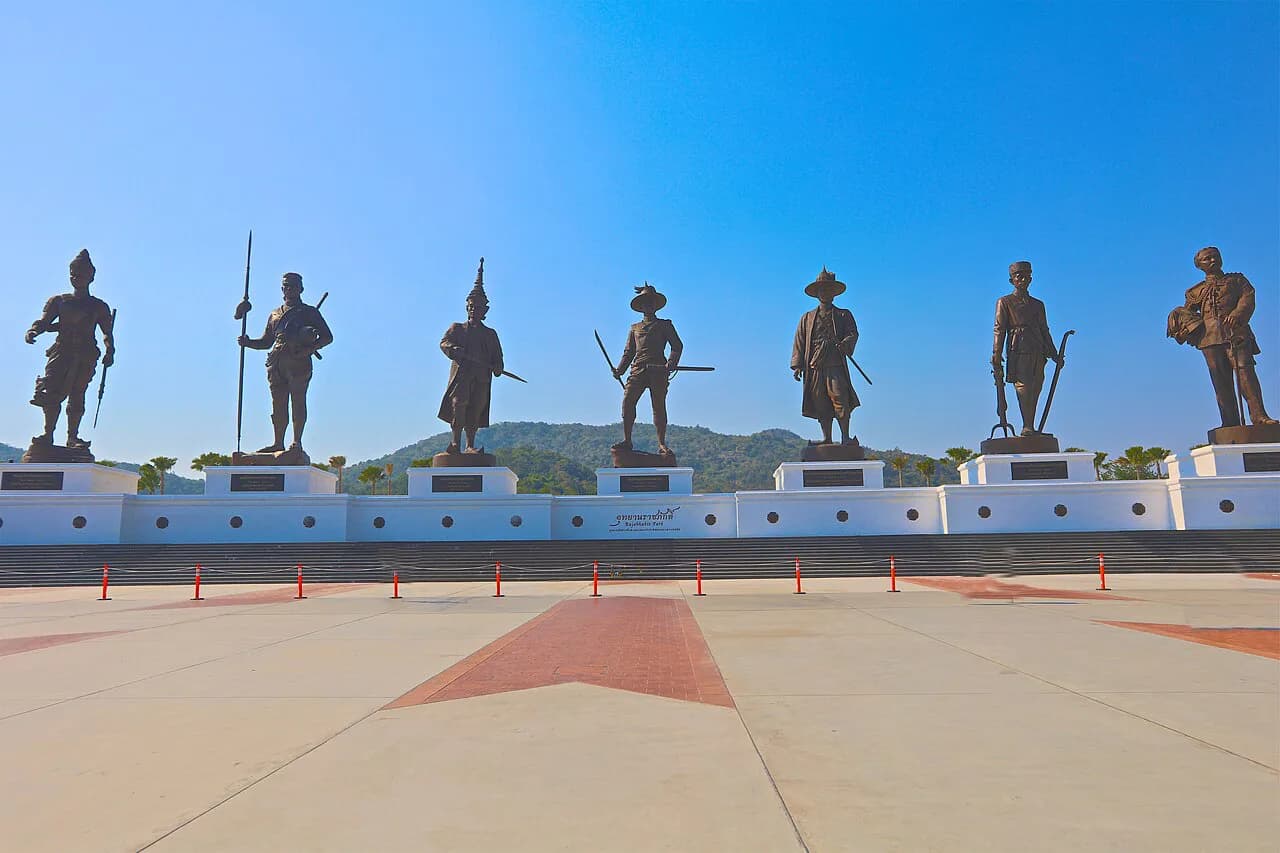
The centerpiece is a row of seven giant bronze statues, with an average height reported at roughly 13.9 meters, standing shoulder to shoulder on the raised terrace. Reading them in order turns a photo stop into a short history lesson, and the figures are conventionally listed from left to right.
From left to right the kings are conventionally listed as Ramkhamhaeng the Great of Sukhothai, Naresuan the Great, Narai the Great, Taksin the Great, Buddha Yod Fa Chulalok the Great (Rama I), Mongkut (Rama IV) and Chulalongkorn the Great (Rama V). That sequence runs from the Sukhothai era through the early Chakri reigns, which is exactly why the park frames itself as a sweep of royal history rather than a single dynasty's tribute. This ordering comes from an independent enthusiast listing rather than a published park or army notice, so use it as a reading guide rather than an official designation.
Walk the line slowly and look at the faces and stance rather than shooting the whole row from one spot; the terrace is wide enough for a slow pass. Since the statues sit on a raised terrace off a busy highway, plan to lock up or park and continue on foot regardless of how you arrive.
The plaza and the museum at the base
The plaza is the large open apron between the entrance and the statues, and its scale is best appreciated by crossing it on foot. It is used for ceremonies and events, so on some days part of it may be cordoned or occupied; if that happens, follow the marked routes rather than cutting across.
The museum building sits at the base of the royal monument and holds collections on Thai royal history and the royal duties of the seven kings, spanning the Sukhothai to Rattanakosin periods. It gives context that the statues alone cannot, so check whether it is open on the day you visit before planning your time around it.
How long to allow and when to go
A listed recommended sightseeing time of one to two hours is a fair estimate for the statues, plaza and a museum pass. If you only want photographs of the kings from the terrace, an hour is enough; add time if you read the inscriptions and go through the museum.
The site is largely open paving with little shade along the plaza, so early morning or late afternoon is more comfortable than midday. Photography is often better in the softer light at either end of the day, and you avoid the worst of the reflected heat off the stone.
Opening hours and ticket details
The park is listed as open 08:00–18:00, but that comes from a third-party travel listing rather than a published park notice, so treat it as indicative and verify before you build a day around it. Check hours again on the day you travel, particularly around public holidays or ceremonial events on the plaza.
No entry price appears in available sources, so do not budget on a figure quoted elsewhere; confirm the current ticket and museum arrangements at the gate or by phone before setting out. The listed contact number for ticket inquiries is +66-649318466, which is the fastest way to check whether the museum is operating on your date.
Nearby stops to pair with the park
Because the park sits south of the center on Phet Kasem Road, it makes sense to pair it with Khao Takiab at the southern end of Hua Hin Beach, where the hilltop temple gives you a contrasting coastal stop. The two are close enough to link in one ride, and you can finish with dinner back toward town.
If you are staying near the center, a stop at Cicada Market in the Khao Takiab area gives the day a natural endpoint. Confirm its current opening days before you rely on it, then plan your park visit earlier in the afternoon.
For a broader set of options in the area, including beach days and temple stops, work from the full Hua Hin Attractions: Plan Your Beach and Temple Stops guide and slot the park in where the geography suits you.
Is Rajabhakti Park worth the ride south?
Yes, if you set expectations at one to two hours and treat it as a monument to read rather than a temple to explore. The payoff is the sheer scale of seven bronze kings above an empty plaza, which is unlike anything in central Hua Hin and easy to combine with a beach stop at Khao Takiab.
Skip it if your Hua Hin time is tight and you want markets, sand and food within walking distance of the clock tower. And before you go, confirm the listed hours and current ticket arrangements directly, since neither is published by an official park source in a form you can rely on.