
Police Boat 813, Khao Lak: What to See at the Bang Niang Tsunami Memorial

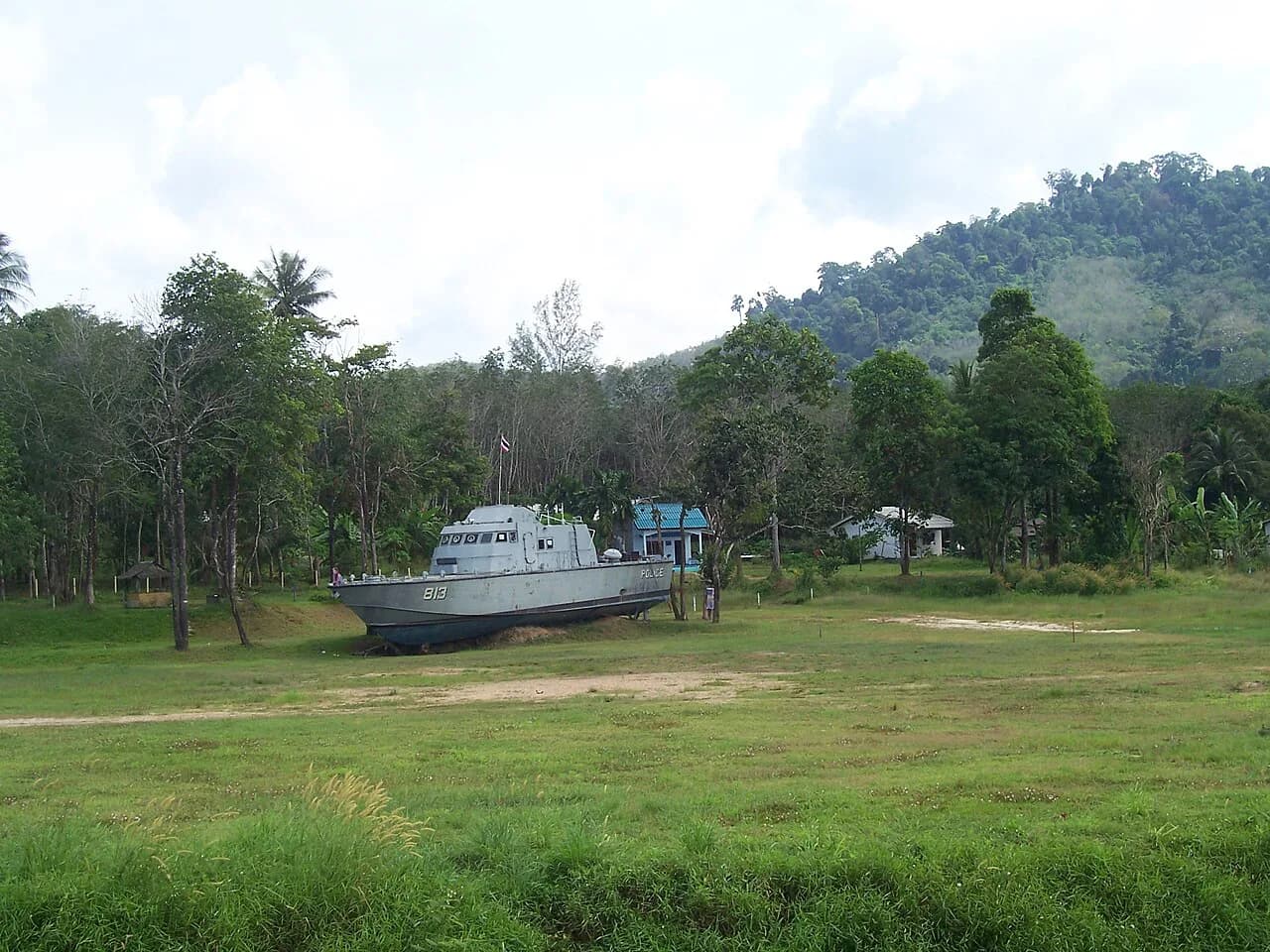
Police Boat 813 is one of the most striking stops in Khao Lak, and it takes under an hour to see properly. The boat was anchored offshore on the morning of 26 December 2004; the tsunami picked it up and left it roughly 2 km inland, where it still sits on dry ground in Bang Niang. This page covers where the memorial is, how to reach it, what you see along the path, how much time to allow, and what to pair with the stop.
Where the boat sits in Bang Niang
The memorial sits just off Highway 4 in Bang Niang, on the opposite side of the road from the afternoon market. Coming from the south, watch for a monument sign marked "813" at the entrance, positioned right before the Bang Niang traffic light. From central Khao Lak it is a short run of about 2 km, which is roughly a five-minute drive.
The entrance is easy to miss if you are watching traffic rather than signage, so slow down once the light is in sight. Inside, the site is tucked among trees and ordinary buildings rather than laid out as a polished attraction. If you are staying along Bang Niang Beach, Khao Lak's long central strip, the memorial is close enough to add to a morning that already includes the sand.
Two kilometres does not sound like much until you stand beside a 60-ton patrol boat resting on dry land, far from any water. That gap between the boat and the sea is the detail that makes the site register before you have read a single panel. It is also why the stop rewards a few minutes of quiet looking before you start walking the path.
How the boat got here
On 26 December 2004, an earthquake off the west coast of northern Sumatra sent waves across the Indian Ocean into Thailand's Andaman coast. Police Boat 813 was at anchor about one nautical mile offshore at the time, on duty protecting members of the royal family then staying at La Flora Resort. The waves carried it inland to Bang Niang, where it has remained as a memorial ever since.
Sources give the loss of life in the thousands, with the Khao Lak area among the hardest hit in Thailand, though the figures vary between accounts. Treat any specific number you read on site or hear from a guide as an approximation rather than a precise record. The boat itself is the more honest memorial: the scale of what moved it needs no statistics.
What you see along the path
From the entrance you walk down a short lane, cross a small bridge, and the hull comes into view ahead of you. Information panels around the boat lay out what happened on the day, and the boat is kept in good repair rather than left to rust. Do not expect a curated museum experience here: the boat is the draw, and the surroundings are modest.
Further along the path stands the memorial sculpture building, a structure whose flowing design echoes the shape of a wave sweeping inland. This is where the visit slows down, and it is worth sitting with for a few minutes instead of treating it as a backdrop for a photo. Visitors who rush between the boat and the car park miss the part of the site that asks the most of you.
The grounds are still fairly plain, and a small International Tsunami Museum sits nearby rather than being woven into the park itself. That sparseness is part of the experience: this is a place for reflection, not an attraction with signage at every turn. Arrive expecting quiet and you will get more out of it than you would from a slicker presentation.
Getting there without a car
If you are not driving, a taxi or a Grab ride from your hotel is the practical option, and the trip from the central Khao Lak strip is short enough that the fare stays modest. Give the driver "Police Boat 813" or "Tsunami Memorial Bang Niang" rather than an address, and point to the 813 sign on Highway 4 if there is any confusion. Booking through an app also avoids negotiating a return pickup in an area where through traffic is thin.
Drivers coming south from Khuk Khak or north from the Takua Pa side will find the memorial on the same stretch of Highway 4 that links most of Khao Lak's beaches. Parking is available at the site itself, so there is no reason to leave the car on the shoulder. Build the stop into a wider half-day on the highway rather than making a dedicated trip.
How long to allow
Plan on about 45 minutes to an hour: long enough to read the panels around the hull, walk to the sculpture building and sit for a while. Some visitors spend well over an hour, especially if they arrived with a guide who can fill in the sequence of events. Either pace works, and there is no queue or timed entry pushing you along.
The stop suits an early morning or late afternoon slot, when the light is softer and the site is quiet. It pairs naturally with the market across the road, which is at its busiest in the afternoon, so a late-afternoon visit covers both in one run. If you are working through a shortlist of Khao Lak Attractions, this is the one to schedule rather than squeeze in.
Admission and hours
Entry to the 813 Tsunami Memorial Park is free, and anyone can walk or drive in to pay their respects. Khao Lak Center lists the site as open daily from 8:30 AM to 6:00 PM, which is a useful guide for planning rather than a guarantee. Check those hours again before you set out, particularly if you are visiting on a public holiday.
Because the memorial is a modest site rather than a ticketed attraction, it can work as a brief pause if you are passing through Bang Niang on the way somewhere else. Confirm current access details locally if you are planning a visit around a specific event.
The nearby museum
The small International Tsunami Museum close by adds photographs and a more conventional exhibition to what you have seen outdoors. It is a separate stop with its own entry arrangement, so treat it as an optional extra rather than part of the park. If you want the fuller picture of the tsunami memorial museum Khao Lak has to offer, this is the place to extend the visit.
Whether to add it depends on how much context you want. The outdoor memorial carries the emotional weight on its own; the museum is better for anyone who wants timelines, images and background before or after seeing the boat. Allow another 30 to 45 minutes if you go in.
Do not confuse it with Ban Nam Khem
Khao Lak has more than one tsunami memorial, and the one in Ban Nam Khem, further north in Phang Nga province, is a separate site with its own memorial wall and museum. Travelers who search for a "tsunami memorial park" sometimes end up at the wrong one and miss Police Boat 813 entirely. If your plan is to see the boat, navigate to Bang Niang and look for the 813 sign on Highway 4.
If your time in the region is limited, the Bang Niang site is the more compact of the two and sits on the main highway through the beach strip. Ban Nam Khem rewards a longer detour and suits travelers with a car and a free half-day. Choose one, see it properly, and leave the other for a return visit.

What to pair with the stop in Bang Niang
The afternoon market sits directly across Highway 4 from the memorial entrance, which makes it the obvious companion stop. Wander through after you leave the park for food stalls, fruit and everyday shopping rather than souvenirs built for tour buses. For a fuller picture of that market's days and layout, the dedicated guide covers it in more detail.
Bang Niang's beach is a short ride west of the highway, and a morning at the memorial followed by lunch near the sand makes a sensible half-day. Heading the other way, Cape Pakarang to the north is another outdoor stop that works with a car. Any of these can be worked into a wider plan of the things to do in Khao Lak without much extra driving.
If you are based nearer Khao Lak Center or Lam Kaen, the drive up Highway 4 to Bang Niang is short enough to combine with a beach afternoon. Lam Kaen in particular sits on the southern end of the strip and puts you on the right side for an easy run north. Pick your beach according to where you are staying and let the memorial fit into the route rather than dictate it.
Is Police Boat 813 worth an hour of your Khao Lak trip?
Yes, and the argument is simple: this is the one stop in Khao Lak that explains the place you are standing in. It costs nothing, takes under an hour, and sits on the highway you are probably already driving. Bring a little patience for the quiet, give the sculpture building more than a glance, and skip the shopping-stall pace you use elsewhere.
If you only have time for one memorial, make it this one; if you have a car and a free afternoon, add Ban Nam Khem and the museum for the wider story. Either way, check the site's current hours before you go and treat the published times as a guide. The boat is not going anywhere, and it is worth arriving unhurried.
Explore more Khao Lak guides
Frequently Asked Questions
Do I need a guide to visit Police Boat 813?
No. The site is open to walk-in visitors, the information panels around the hull explain what happened, and a visitor can see the boat and the sculpture building without assistance. A guide adds context on the sequence of events and the royal family connection, and some Khao Lak tours include the memorial as a stop, but nothing on site requires one.
Can I walk to Police Boat 813 from Bang Niang Beach?
It is a short distance from the beach area to the Highway 4 entrance, but the walk crosses a busy road and is best done in daylight. If you are staying elsewhere in Khao Lak, a taxi or ride-hailing car is the easier option, since the memorial sits on the highway rather than on the sand.
Is the memorial appropriate for children?
Older children who already know something about the 2004 tsunami can take a lot from the site, and the boat itself is vivid enough to hold attention. For younger children, keep the visit brief and set expectations beforehand, since the site is a place of remembrance rather than a play area. The nearby museum's photographs are more direct, so judge whether that suits your family before going in.