
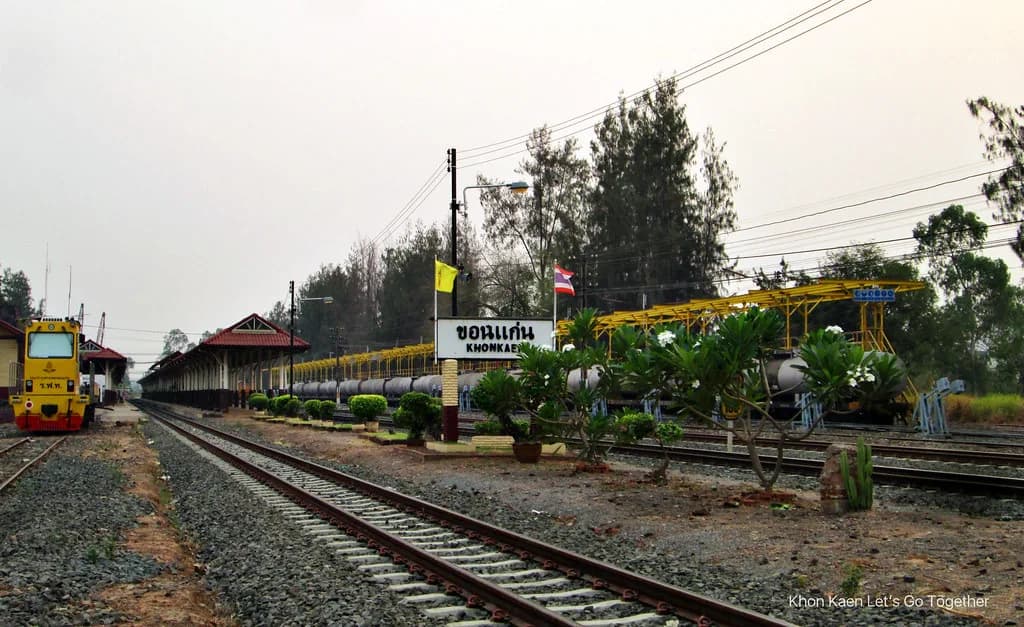
Khon Kaen Railway Station: A Rider's Guide to Isan's Main Line Stop
Treat Khon Kaen Railway Station as a working main-line stop rather than an attraction, and allow about 40 to 60 minutes on site before departure instead of a quick photo stop. It sits on the Nong Khai–Bangkok corridor through Isan, the route most travelers use to move between the northeast and the capital. This guide covers where the station is, how to reach it, how booking works, and what the journey south looks like.
What Khon Kaen Railway Station is and where it sits
The station is the city's rail gateway on the northeast line running between Nong Khai and Bangkok. It is a functional stop with a ticketing hall and platforms rather than a heritage building you tour, handling a mix of long-distance sleepers, day trains and short regional hops.
Relative to central Khon Kaen, the station sits on the city's rail side rather than in the restaurant and hotel cluster around the lake and university road, so you will almost always take a short ride to reach it. Confirm the exact address with the State Railway of Thailand before your trip, because map pins and third-party listings drift. If you are building a wider city day, the Khon Kaen attractions overview is the better starting point for what surrounds the station.
Which line the station serves and where trains run to
Khon Kaen sits on the main line carrying trains from Nong Khai in the far northeast down through Isan toward Bangkok. Southbound, the service threads through Ban Phai, Bua Yai Junction, Ayutthaya and Don Mueang before reaching the capital's Krung Thep Amphiwat Central terminus, while northbound the same line continues toward the Lao border.
Do not rely on any fixed journey time you read online, including the roughly 450-kilometer road distance sometimes quoted for the drive. Rail timings shift with the season, track work and the service you book, so check the current timetable before committing to a same-day connection in Bangkok. The practical question is not distance but which departure leaves you the buffer you need.
Khon Kaen has a long-term light rail project on paper, and a Thai-built tram has only run test trips rather than passenger service. Do not plan around a city rail network that is not carrying riders yet; for now, the main-line station is the rail option that matters.
How to reach the station from central Khon Kaen
Songthaews, tuk-tuks and Grab are the realistic ways to cover the last leg, and Grab is the easiest to price before you commit. A songthaew is cheaper but runs a shared route, so you need to know which one passes the station side of town. Ask your hotel to write the station name in Thai for the driver, and leave 15 to 20 minutes beyond the ride itself.
If you are coming from the campus side of the city, allow extra time, since the university area sits away from the rail corridor. A visit to Khon Kaen University and a train departure in the same half-day is doable but leaves little room for delays. Bag storage is not something to count on at a provincial station, so arrive with your luggage rather than planning to stash it.
Buying tickets: counter versus online
Buying at the counter a few days ahead is the low-friction option, and it lets you see the seat map and ask about sleeper classes directly. Travelers who booked in person three days out got the class they wanted on the Bangkok run, though some seats face backward relative to the direction of travel. If facing forward matters, say so at the window before the ticket prints.
The online booking path exists but is widely described as awkward to navigate, so treat it as a backup rather than the default for a short-notice trip. Station information aggregators can show routes and departures, which helps you shortlist services before you queue. Whatever you book, keep a screenshot of the confirmation in case the platform display and your ticket disagree.

What the station itself is like
Expect a compact provincial layout with a ticketing hall and a platform area with a timetable display, rather than a grand concourse with anything to tour. The station's value is logistics, not atmosphere. Do not count on a full food court inside; buy water and snacks before you go through to the platform.
Smaller stops on this line have no raised platform at all, which tells you something about the network's character even if Khon Kaen itself is more developed. Do not count on airport-style signage or English announcements; watch the display and the carriage number on your ticket.
What the ride south toward Bangkok passes through
South of Khon Kaen the train crosses farmland and stops at Ban Phai, Mueang Phon and Nong Bua Lai before the line splits at Bua Yai Junction, where the track toward Korat diverges. One traveler's account describes a wind farm in Chaiyaphum Province along the way and the railway following the edge of the Pasak Chonlasit reservoir, crossing water in a few places — a stretch that account called the floating railway.
Closer to the capital the scenery turns suburban, with stops at Ayutthaya and Rangsit before Don Mueang, which sits next to the airport. If you plan to hop off at Ayutthaya, book that leg deliberately rather than treating it as a spur-of-the-moment stop with luggage. The final arrival is at Krung Thep Amphiwat Central.
Seat classes and comfort on long-distance trains
In one first-class account of this route, carriages were air-conditioned with roomy reclining seats and large windows, and staff passed through to help. That matters on a long day run, where the difference between classes is mostly air conditioning and elbow room. Ask about sleeper options if you are traveling overnight rather than by day.
One quirk to plan around: some seats face backward to the direction of travel, so a forward-facing seat is not automatic even in a good class. If you are prone to motion discomfort or want to watch the scenery ahead, request a forward seat explicitly, and confirm the class layout at the counter when you buy.
Food and drink on board versus at the station
In that same traveler's account of the Khon Kaen–Bangkok service, hot food in containers had to be pre-ordered (about 50 baht) rather than sold off a trolley at will. If eating on board matters to you, ask at booking or at the station whether meals are available on your specific departure; otherwise, buy your own supplies before boarding.
At the station end, keep it simple: water, fruit and packaged snacks are the reliable purchases. Do not assume a sit-down restaurant inside the station or plan a meal around a tight departure. A small local eatery near the station is a safer bet than a platform kiosk if you have 30 minutes or more.
How much time to allow before departure
Aim to be at the station 40 to 60 minutes early for a long-distance departure with luggage, and 20 to 30 minutes for a short regional hop. That covers the counter queue, a bathroom stop and finding the right platform without rushing. If you are buying a ticket on the day rather than collecting a booked one, add another 15 minutes.
Trains on this line can run late without much ceremony; the same account recorded a one-hour delay that the waiting crowd did not treat as unusual. Build slack at the arrival end too, especially if you have a flight out of Don Mueang or a Bangkok hotel check-in. A relaxed buffer turns a delay into an inconvenience rather than a crisis.
Delays: why to build slack into a connection
The single most useful habit at this station is to avoid same-day connections that depend on the train being punctual. If you are heading to Bangkok to fly, consider an overnight in the capital rather than a tight link from Krung Thep Amphiwat Central to the airport. For onward links to Ayutthaya or Don Mueang, leave several hours between the rail arrival and the next commitment.
Announcements at provincial stations are limited, so a delay can be quiet rather than dramatic. Keep an eye on the platform display, ask staff if you are unsure, and stay near the platform once departure time approaches.
Nearby in Khon Kaen to pair with a station visit
Because the station itself needs well under an hour, treat it as one part of a city day rather than the day's destination. Evening markets are the natural pairing, and Ton Tann Market, Khon Kaen is a good anchor for a food-focused evening after a morning train. Leave a gap between the two so a delay does not eat your dinner plans.
If you want a cultural stop before departure, Phra That Kham Kaen is the city's sacred stupa and fits a shorter visit. Pair it with the station only if your train leaves in the afternoon, since the two sit apart and the ride between them adds time.

Where to check the current timetable, fares and station address
Timetables, fares and the station's exact address change more often than any guide can track, and the State Railway of Thailand is the authority for all three. Station pages from booking aggregators can help you shortlist routes and departures, but confirm the address locally before you set out.
For a sanity check on the route, accounts of the Khon Kaen–Bangkok run give a useful picture of the stop sequence and carriage conditions; read them as background, not as a schedule.
Is the station worth building a day around?
No, and that is the point: Khon Kaen Railway Station is a means of getting somewhere, not a sight in itself. Budget under an hour on site, arrive 40 to 60 minutes before a long-distance departure, and buy tickets at the counter a few days ahead if you can. Then spend the rest of your day on the city rather than the platform.
The payoff of planning it well is a comfortable ride south through Isan farmland and reservoir crossings toward Bangkok, or a smooth link to Ayutthaya and Don Mueang. Build slack on both ends, request a forward-facing seat, and confirm times with the operator before you travel.