
Wat Plai Laem: Visiting Koh Samui's Guanyin Temple
Wat Plai Laem needs 30 to 60 minutes, not a morning. The compact complex on Koh Samui's northeast coast packs an 18-arm Guanyin, a big white laughing Buddha and a fish-filled lake into one short, photogenic stop that pairs naturally with the Big Buddha a few hundred meters away. This guide covers what you are looking at, where the temple sits, how to reach it from Choeng Mon, Bophut or Chaweng, and how to fold it into a half-day on the island.
What Wat Plai Laem actually is
This is a modern Buddhist temple rather than an ancient ruin, and its design deliberately mixes Thai and Chinese elements. Much of the layout and statuary was shaped by the Thai artist Jarit Phumdonming, which helps explain why the headliner here is Guanyin, the Goddess of Mercy and Compassion, rather than a conventional seated Gautama Buddha. Treat it as a living, active place of worship, not an open-air museum.
The site was restored and repainted after the floods of March 2011, so the colors you see are relatively fresh and the paintwork is bright rather than weathered. Because the complex is small, you can walk the whole thing slowly and still see everything, which is why it works as a 30-to-60-minute stop rather than a destination in itself. If you want the broader island context, the Koh Samui attractions: plan a beach-led day of sightseeing guide shows how this temple fits among the island's other sights.
Where it sits on the northeast coast
Wat Plai Laem sits at Plai Laem on the northeast coast, addressed along Chaweng Choengmon Road. It is a short ride from Wat Phra Yai, the Big Buddha temple, which sits a couple hundred meters away, and roughly 3 km from Samui International Airport. The usual approach by road is up Route 4169 to the northeast, then a turn onto Route 4171.
Because the temple is on the northeastern tip of the island, it fits most cleanly into a day when you are already staying or traveling around Choeng Mon or Bophut. From the busier Chaweng Beach side you are crossing the island, so it makes sense to combine the temple with the Big Buddha and a beach stop rather than making a dedicated round trip.
How to get there from Choeng Mon, Bophut and Chaweng
Songthaews, tuk-tuks and ride-hailing apps such as Grab are the usual ways to reach the temple, and most drivers in the northeast know it by name and by its proximity to the Big Buddha. A simple instruction is to ask for Wat Plai Laem near the Big Buddha at Plai Laem, which avoids confusion with other temples on the island. Fares are negotiated or metered by app and are not published here, so agree the price before you get in a songthaew or tuk-tuk.
If your base is Bophut or Fisherman's Village, the drive up the northeast coast is short enough to combine with a morning at the temple and a swim afterward. From Chaweng the trip is longer, so build it into a loop that includes the Big Buddha and a beach rather than treating the temple as a standalone outing.
The 18-arm Guanyin
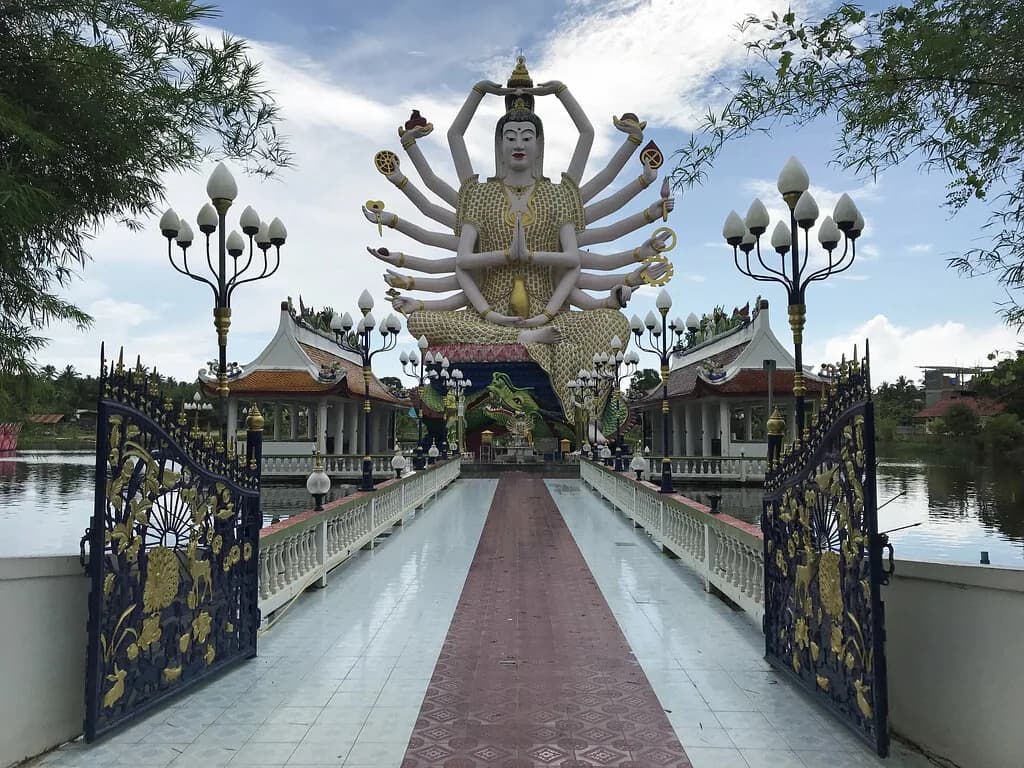
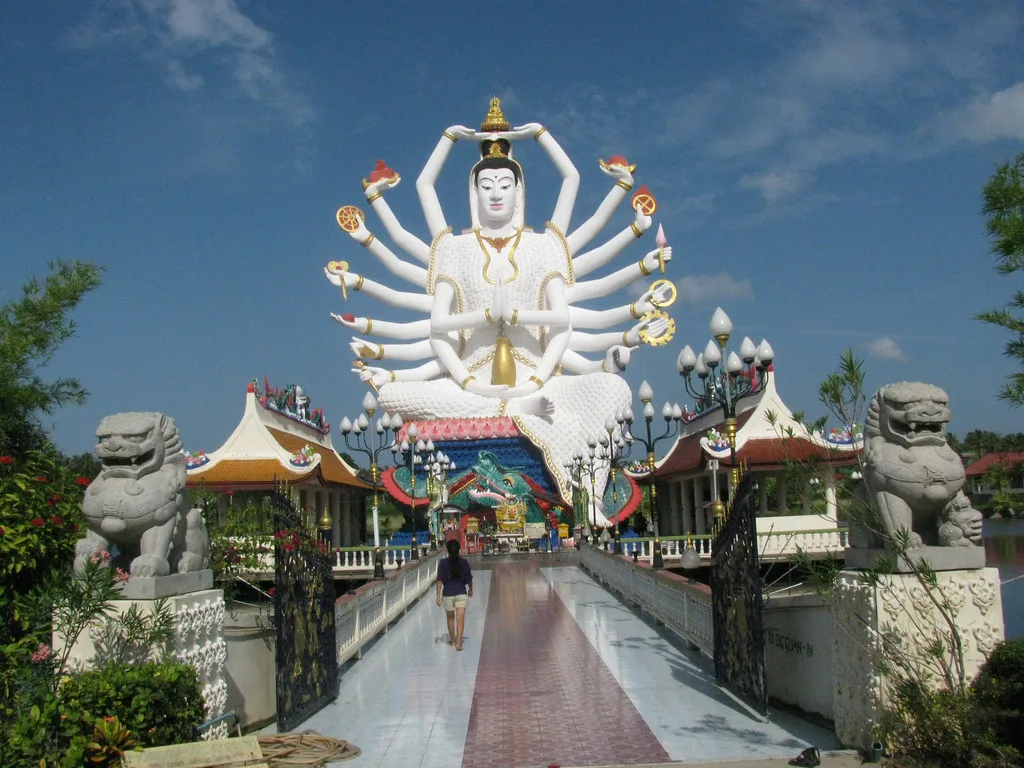
The signature statue is an 18-arm Guanyin, the Goddess of Mercy and Compassion, and devotees come specifically to pay homage to her. That is why the temple feels lively rather than sleepy: people arrive to pray, not just to photograph, and the atmosphere shifts with the flow of worshippers through the day. Give the statue a few quiet minutes rather than rushing past on the way to the lake.
Guanyin is a Chinese Bodhisattva figure, and her prominence here is the clearest sign of the temple's Chinese influence. If you have already seen the Big Buddha, the contrast is the point: two adjacent sites with different devotional traditions and very different visual styles. Reading the surrounding statuary as a pair makes each stop more interesting than ticking either one off alone.
The white laughing Buddha
A large white laughing Buddha, painted white, red and gold, dominates one side of the complex. Third-party guides commonly put the figure at around 30 meters high, a number worth treating as a commonly cited estimate rather than a verified measurement. In Chinese tradition the laughing Buddha represents wealth and prosperity, which is why he draws a steady stream of visitors alongside the Guanyin.
The scale is what makes the stop worthwhile: a fat, cheerful figure at that size is a genuinely unusual sight, and the white-and-gold coloring photographs well against the sky and the lake. Because everything is clustered closely, you can see the laughing Buddha, the Guanyin and the hall without any real walking between them.
The lake, the island hall and the fish
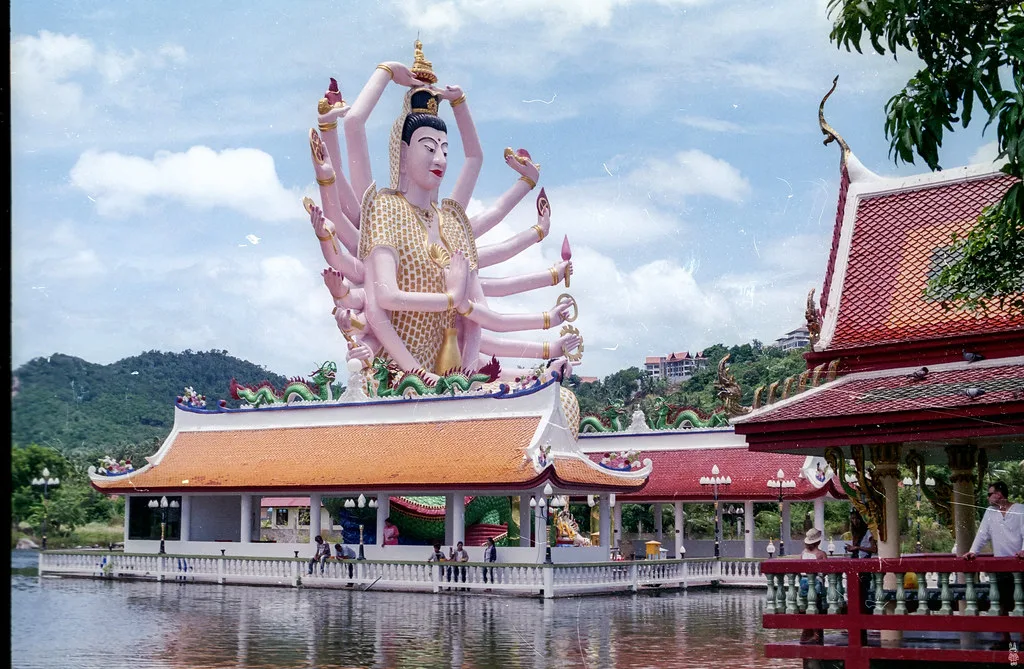
The complex is built around a lake full of fish, and a ceremonial hall sits on its own small island in the water. Look for the carved entry doors and the murals and paintings depicting the life of the Buddha, which are the detail most visitors miss when they only photograph the big statues. The hall is an active ceremonial space, so walk quietly and give way to anyone who is praying.
Feeding the fish is the one small optional spend on site: visitors make a donation and receive a bag of fish food, and releasing fish or turtles into the water is done as a way of gaining merit. The donation amount is not published in any reliable form, so pay what is asked on the day and keep small notes handy. It is a low-key, five-minute pleasure that children tend to remember longer than the statues.
How much time to allow
Thirty to 60 minutes covers the Guanyin, the laughing Buddha, the lake hall and a slow circuit of the grounds. One visitor guide suggests planning two to three hours, but that figure bundles the temple with the adjacent Big Buddha and the walking between them rather than describing Wat Plai Laem alone. If you are short on time, the temple itself is the compact half of that pairing.
A longer stop makes sense if you plan to sit by the lake, feed the fish, or wait out a passing shower under cover. Add time for the Big Buddha next door, since the two are close enough to visit back to back. If you are building a fuller island day, the things to do in Koh Samui guide groups options by area so you can slot the temple in without backtracking.
Tickets and hours
The only visitor guide that puts figures on entry and hours reports free entry and the temple open daily from roughly 7 AM to 6 PM, but neither comes from an official temple source. Treat those hours as indicative and confirm on arrival or through your hotel before making a special trip. Any bag of fish food is a separate donation rather than an entrance fee.
One source describes the temple as open to visitors all day, which is looser still, so the honest position is that published times vary and none of them are official. Check current details the day before you go, especially if you are squeezing the temple into an early morning or late afternoon. Places of worship can also close to tourists without notice for ceremonies, which is worth keeping in mind.
What's nearby
Wat Phra Yai, the Big Buddha, is the obvious add-on and sits a couple hundred meters away, making the two temples one natural half-day. Beyond that, Choeng Mon Beach is the closest place to cool off afterward. On the other side of the island, Lamai Beach and the Hin Ta Hin Yai rock formations make a separate southern outing rather than part of this loop.
If you are heading north later in the day, Maenam Beach is a quieter stretch for sunset than the Chaweng side. Silver Beach is another small bay worth knowing about if you want a swim between temple stops. One source mentions visiting during Chinese New Year for extra liveliness, but no confirmed schedule is published, so verify locally if timing matters to you.
Should Wat Plai Laem be its own trip?
No: make it part of a northeast-coast half-day with Wat Phra Yai rather than a dedicated journey across the island. The compact site rewards 30 to 60 minutes of unhurried looking, a few minutes with the Guanyin, and a stop at the lake before moving on. Budget nothing for entry according to published reports, but carry small notes for fish food and confirm the current opening times before you set out.
Frequently Asked Questions
Is Wat Plai Laem free to enter?
A third-party visitor guide reports free entry, but no official temple source confirms it. Treat that as indicative and check on arrival, since any fish-food bag is a separate donation rather than a ticket.
Can you visit Wat Plai Laem and Big Buddha in one trip?
Yes. The two sit a couple hundred meters apart on Koh Samui's northeast coast, so they combine naturally into a single half-day, with Wat Plai Laem taking roughly 30 to 60 minutes on its own.
What is the main statue at Wat Plai Laem?
An 18-arm Guanyin, the Goddess of Mercy and Compassion, is the signature figure, reflecting the temple's Chinese influence. A large white laughing Buddha stands nearby and represents wealth and prosperity in Chinese tradition.