
Railay: A Practical Guide to Krabi's Boat-Only Peninsula
Plan on two nights, not a day trip, if you want Railay at its best: the hours after the last day boats leave are the whole point. Railay is a peninsula on Krabi's coast that you can only reach by longtail boat, and that single fact decides where you sleep, what you carry and what the place costs. For how the peninsula fits alongside Ao Nang, Krabi Town and the quieter coast, see Krabi neighborhoods: where to base your beach days.
Most visitors treat it as a beach stop, but it is really several places in one: Railay West for sunsets and resort dining, Railay East for cheaper beds and the walking street, Phra Nang Beach at the southern end for the cave shrine, and Tonsai around the headland for the cheapest and quietest stay. This guide separates them by character and cost so you can pick where to sleep, and covers the boats, the viewpoint scramble and the practical limits.
What Railay actually is, and what the missing road changes
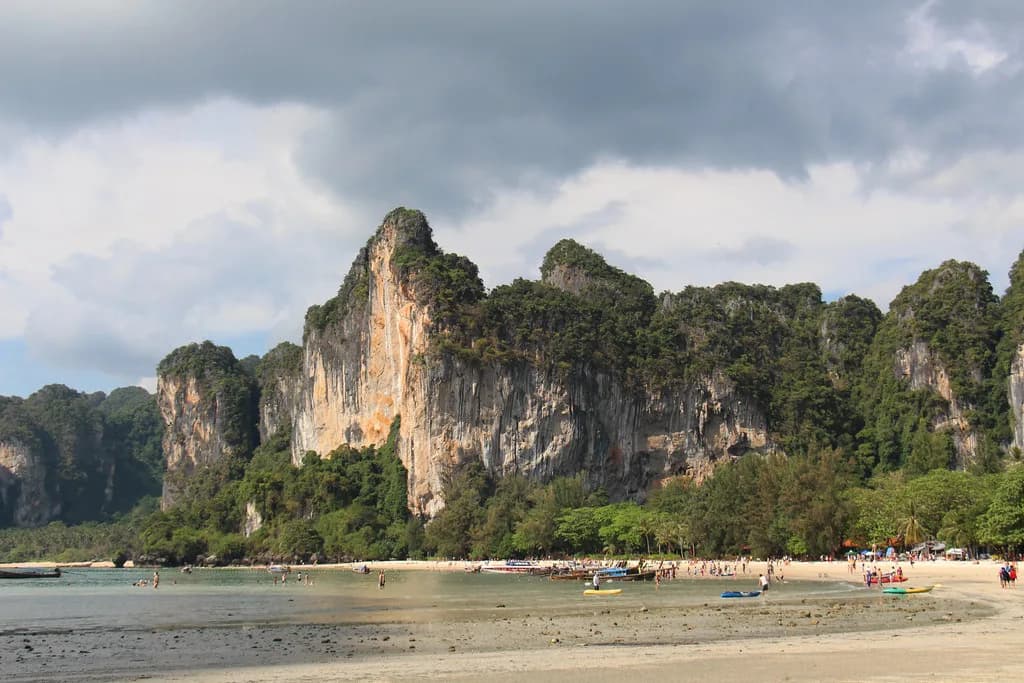
Railay sits just south of Ao Nang but is cut off from the road network by the limestone cliffs behind it, so it keeps an island feel without being an island. The main beaches face west toward sunset and east across the bay, with Phra Nang Bay at the southern tip. For the road-linked alternative next door, see Ao Nang, Krabi: Beach Base Guide for What's Worth Your Time.
The no-road rule ripples through the trip. Luggage gets carried over wet rock and shallow water, supplies arrive by boat so everything carries a freight premium, and you cannot simply walk out when you feel like it.
In practice that means packing lighter than you would for a city stop, bringing cash, and treating the boat schedule as the frame of your day rather than an afterthought. It also means the place empties in the late afternoon, which is the best argument for staying.
The four sides of the peninsula, and how they fit together
Railay West is the postcard: a wide curve of pale sand facing sunset, lined with the more upmarket resorts and their restaurants. In fact all the West-side restaurants are attached to a resort, but non-guests are welcome to dine there, and the beach is the obvious place to end the day.
Railay East is the working side, where the walking street connects the piers to the resorts and the accommodation is cheaper and more basic. Boats to Krabi Town and Ao Nam Mao dock on this side, which makes it the practical base if you are moving on.
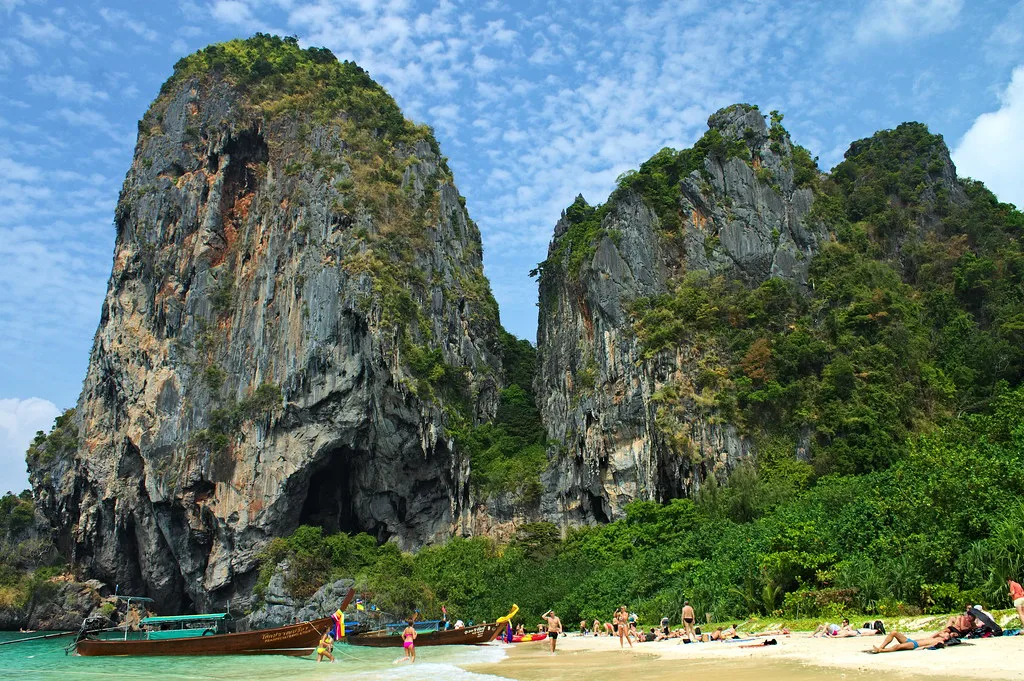
Phra Nang Beach lies beyond the West beach toward the peninsula's tip, reached on foot, with the cave shrine at its far end. Tonsai is around the headland from Railay West, cheaper still and reachable by a short trail or, at low tide, by walking around the rocks.
Everything sits within walking distance of everything else, which is the joy of the place, but the paths between East and West involve stairs, roots and mud. Allow more time than the map suggests, especially with a bag.

Who Railay suits, and who should base in Ao Nang
Railay is for climbers, couples who want sunset over the bay, and anyone who wants karst scenery up close rather than from a boat deck. It also suits budget travelers willing to trade comfort for quiet, particularly on the East side and at Tonsai.
It is a poor fit if you want to come and go freely, keep a rigid schedule or travel with heavy luggage. There is no road, boats stop in the evening, and boarding can mean wading. Travelers who need that freedom are better off basing in Ao Nang instead and keeping Railay as a day trip.
Day visitors are perfectly well served here too: a very large share of people who record Phra Nang never sleep on the peninsula. If you only have an afternoon, come for the beach and the cave shrine and skip the scramble.
Getting there by longtail from Ao Nang, Ao Nam Mao and Krabi Town
The standard approach is a longtail boat from Ao Nang beach, with boats running to the West side; a Krabi-based operator puts the ride at about 15 minutes. From Krabi Town's old Chao Fa pier the ride runs around 30 minutes to the East side, and Ao Nam Mao pier on the way to Fossil Shell also serves Railay. The Klong Muang, Krabi: A Quiet Beach Base Near Ao Nang guide covers a calmer, road-linked base up the coast if you would rather not commit to the peninsula.
Boats run from early morning onward, and during the day you can buy tickets from booths along the Ao Nang beach road. Sources disagree on the last boat: a Krabi operator says boats run until late at night, while a travel planner says there is no scheduled boat after around six in the evening. Fares are set locally and vary by departure point, so agree the price before you board and confirm the actual last return boat at the booth rather than relying on any fixed timetable.
The ride is short but wet: longtails beach at the sand and you step off into shallow water, so wear shoes you Don't mind soaking and keep electronics in a dry bag. Arriving at low tide means a longer wade.
What to do: Phra Nang Cave, the viewpoint scramble, climbing and kayaking
Phra Nang Cave sits at the far end of Phra Nang Beach, its shrine filled with carved wooden offerings left by fisherfolk for the spirit the bay is named after. It is a short walk from the West beach and a natural pairing with a morning swim.
The viewpoint hike climbs from Railay East by rope and mud to a panorama over the bay, then descends into a tidal lagoon inside the rock. It is a scramble, not a walk, and the descent is slick after rain, so go early, wear proper shoes and skip the lagoon when it is wet.
Climbing is why Railay became a destination: the limestone walls above the beaches host schools that take complete beginners, and several have long-standing reputations among Thai instructors. Beginner sessions run daily, though the rock gets too hot to grip by afternoon in the dry months, so book a morning slot.
If you would rather see the cliffs from the water, kayaking the bay is an option for a self-powered paddle. Wildlife is a bonus, not a guarantee: visitors report dusky leaf langurs in the wooded slopes of Railay East, most often early in the morning, and they should be watched from a distance and never fed.
Boat trips to the Phi Phi Islands and Maya Bay can be booked with pickup from Railay, with early departures timed to reach Maya Bay before the main crowds. Access rules and fees at Maya Bay are set by the operating authority and change, so check with the operator on the day you book.
Where to stay: West-side resorts versus East-side budget beds
Railay West holds the upmarket resorts, where you pay for the sunset and the sand at your door. Railay East and Tonsai have traditionally been the backpacker side, with simpler bungalows and cheaper rates, though still carrying a boat-freight premium.
A quiet middle option is the hilly ground behind Railay East, where properties sit among the trees above the walking street. Railay Hilltop, Railay Garden View Resort and Railay Great View Resort & Spa are all recommended in that vein, but the access involves steep stairs that rule them out for anyone with knee trouble or heavy bags.
Book well ahead: the peninsula has only a few hundred beds, so the shoulder months are forgiving while the dry-season peak is not. If you find Railay full, Klong Muang up the coast is a calmer fallback with road access — see Klong Muang, Krabi: A Quiet Beach Base Near Ao Nang.
Where to eat on the peninsula
On the West side, nearly every restaurant belongs to a resort, but non-guests are welcome and the food ranges from Thai standards to burgers, pasta and pizza. This is where you eat with your feet in the sand and a drink as the sun drops.
The East side is cheaper and more local in flavor, with food cooked hot and spicy the way the kitchen does it, plus buckets of whisky and the odd bar with live music or a fire show. Expect plastic chairs and cushions on bamboo platforms rather than wine lists.
For seafood, the obvious move is grilled fish or prawns at one of the beachfront kitchens. Cash is king on the peninsula: there are only a couple of ATMs, one on each side, so withdraw in Ao Nang or Krabi Town before you cross.
How long Railay needs: two nights versus a day trip
Most travelers give Railay two nights, and that is about right: one full day for the beach and the cave, one morning for the viewpoint or a climb, and two evenings for sunset. The hours after the last day boats leave are when the beach empties and the place becomes what you came for.
A day trip works if your priority is Phra Nang and a swim: come over in the morning and leave before the afternoon rush. What you miss is the quiet, which is the entire trade-off.
The one firm constraint is transport. There is no road, and reports differ on evening service — one visitor-facing planner says there is no scheduled boat after around six, while long-standing local guidance says boats run until late at night — so confirm the last departure when you buy your ticket out and plan dinner accordingly.
Practical limits: no doctor, no police, no post office
There is no doctor, police station or post office on the peninsula. The East side has a tiny pharmacy, but anything serious means a longtail to Ao Nang, and crimes are reported through your accommodation.
Money is the other constraint: with just two ATMs, a failed machine can leave you short. Bring enough baht for meals, boat tickets and incidentals, and treat card acceptance as a bonus rather than a plan.
Weather can override everything. The southwest monsoon from May to October brings rough seas, cancellations and slick rock, and October is the wettest month, so a monsoon booking can mean a day cut off from the mainland.
Krabi Airport connections: think Ao Nang first
Krabi Airport is inland, with no direct boat to Railay. The practical route is a taxi or bus down to Ao Nang, then a longtail from the beach, or a transfer to Ao Nam Mao pier.
That means you handle your bags twice, which is worth weighing against the peace of a road-free stay. If you are arriving late, sleep in Ao Nang and cross in the morning rather than chasing the last boats, whose evening service is not something to count on.
If you have a few days either side, Tubkaek, Krabi's quiet beach strip up the coast, pairs well with Railay for a calmer second half of the trip.
Should you sleep on Railay or visit from Ao Nang?
Sleep on Railay if you can carry your own bag, Don't mind a wet landing and want the peninsula after the day crowds leave. Two nights, an East-side bungalow or a West-side resort depending on budget, and one early morning for the viewpoint or a climb is the shape that works.
Visit from Ao Nang instead if you need flexibility, have heavy luggage or want to keep moving. In that case, book the longtail from Ao Nang beach, go early, confirm the return boat before you set off, and leave the scramble for another trip.