
Wat Rong Khun: A Practical Guide to Chiang Rai's White Temple

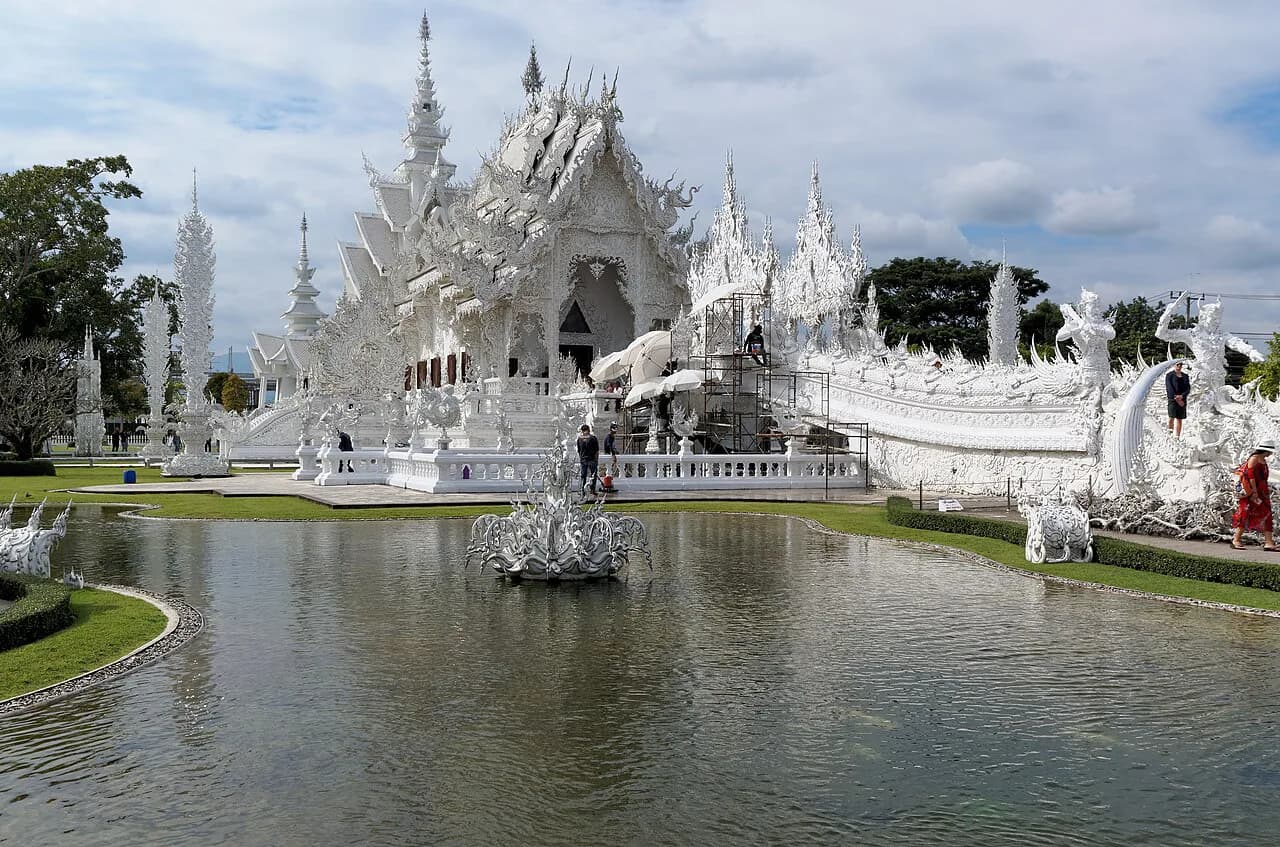
Give Wat Rong Khun about two hours, and arrive early if you can: this is a single site on the southwestern edge of Chiang Rai, not a day out, so the half-day you set aside is mostly travel. The White Temple looks like an ancient sanctuary in photos but is a modern, privately funded Buddhist art installation by Chiang Rai artist Chalermchai Kositpipat, opened to visitors in 1997 and still a working construction site. This guide covers where it sits, how to reach it from the city, the sequence of the visit from bridge to main hall to grounds, and how to confirm current hours and tickets.
What Wat Rong Khun actually is
Kositpipat, a Chiang Rai native trained at Silpakorn University, began building his vision in 1997 and financed it himself rather than through government subsidy, assembling a large team of artists and craftsmen. Architectural Digest describes the result as a privately owned spiritual art installation rather than a state-sanctioned place of worship, which explains why the atmosphere differs from a conventional Thai temple. Expect scaffolding, fresh paint and artists at work somewhere on the grounds, because the project is ongoing rather than finished.
One widely circulated account, a 2017 visitor's blog, says the complex is planned as nine buildings and is not expected to be complete until around 2070. That figure is a single blogger's report rather than a published official schedule, so treat it as the artist's stated ambition rather than a fixed plan; construction at privately funded sites slips, and nothing in the visitor experience depends on the exact finish date. What matters for planning is the practical consequence: some structures may be screened off or partially closed on any given day, and that is normal here.

Where it is and how to get there from Chiang Rai
The temple stands in the village of Ban Rong Khun, roughly nine miles southwest of central Chiang Rai, which puts it outside the walkable core and makes transport your first decision. A hired tuk-tuk or taxi is the straightforward option: the driver waits while you tour, so you are not stranded when you finish, and the round trip is a fixed negotiation you settle before leaving. If you are weighing how this fits with the rest of your time in the area, our Chiang Rai Attractions: 5 Visitor Guides covers the other stops that pair well with it.
The cheap alternative is the public bus from Chiang Rai bus station, a non-air-conditioned ride, or a songthaew, the shared pickup trucks that run local routes. A first-hand account from 2017 put the drive at 20 to 30 minutes and quoted the fares of that time for tuk-tuk, taxi and bus, but those figures are dated and you should ask at your hotel or the bus station counter for what operators charge now. The trade-off is real: the public bus costs least but gives you no vehicle waiting at the gate, so you need to know the return timing before you commit.


Crossing the bridge over the sea of suffering
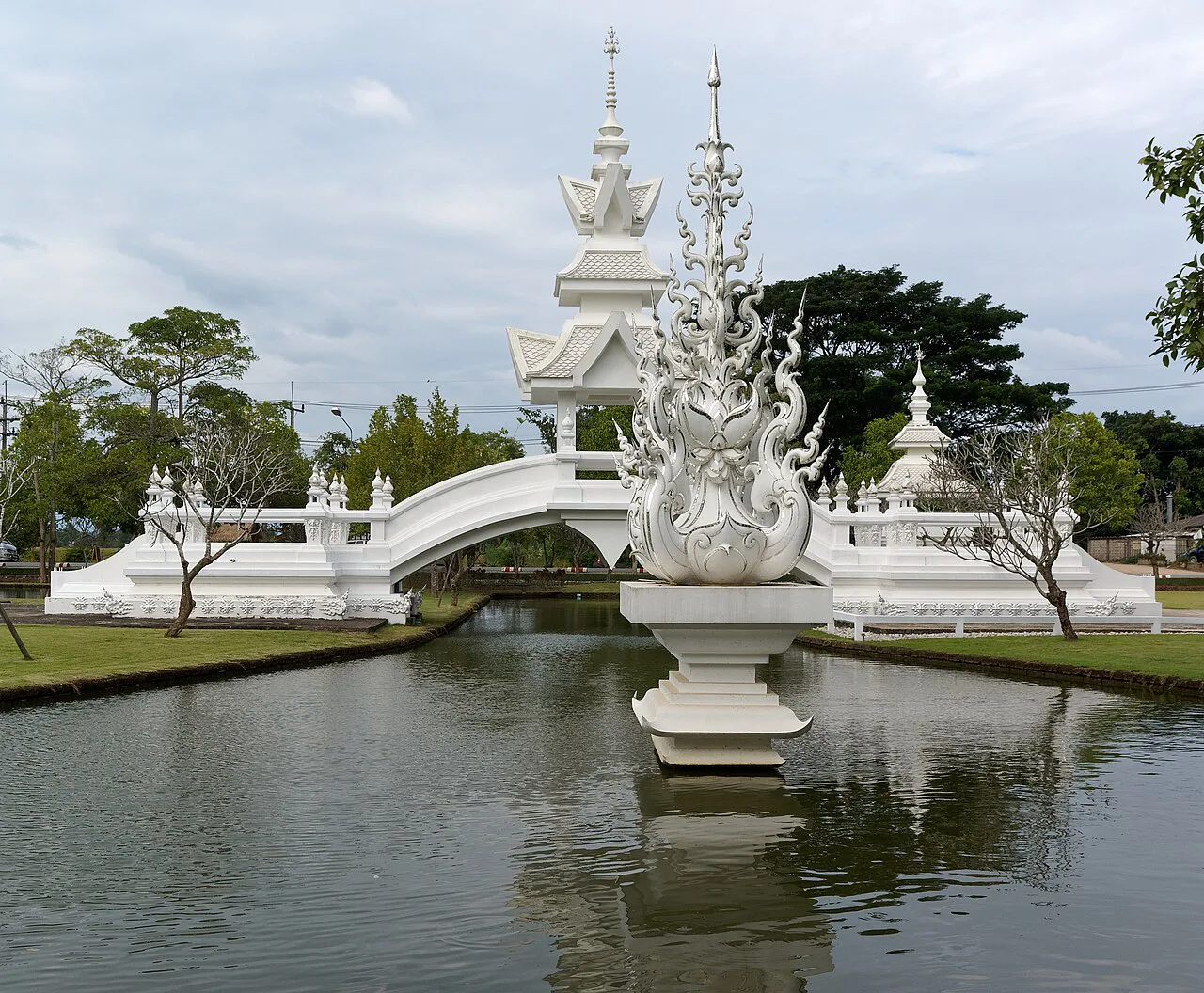
The visit is designed as a symbolic route rather than a set of photo stops, and it begins at the footbridge. You cross a moat flanked by hundreds of outstretched hands, jagged thorns and skulls, a scene meant to represent the suffering and unchecked desire you are symbolically leaving behind as you move toward the main hall. Knowing this in advance changes how you walk it: the point is the passage, not a quick snapshot at the railing.
The head of the bridge is guarded by naga, the serpent deity of Buddhist texts, and figures of kinnara, the half-human, half-bird beings, so look up as well as down at the hands. The bridge corresponds to samsara, the cycle of birth, death and rebirth, and the crossing is staged so that you arrive at the entrance in a particular frame of mind. Move at the pace of the crowd and pause at the far end before stepping inside.
The ubosot exterior and the inside of the main hall
The main hall's exterior is white plaster studded with countless hand-set mirrored fragments that catch the sun, a surface that reads as purity from a distance and as thousands of individual decisions up close. Photographs are not permitted inside the main hall, so the reason to slow down there is straightforward: what you see is what you keep. Read the facade in the open air, then set your camera aside before the threshold.
Inside, Kositpipat's murals mix Buddhist imagery with pop-culture references — tour-operator accounts cite Michael Jackson, The Matrix and Spider-Man — a collision that tour operators note has drawn some criticism within Thailand. Whether you find it playful or jarring, the interior rewards a slow pass along the walls rather than a glance at the Buddha image. Expect a press of people in high season, which is another argument for early arrival.
The rest of the grounds: prayer plates, sculptures and the gallery
Most visitors spend their energy on the bridge and hall and then leave, which is a mistake. Walk the surrounding grounds for the smaller buildings and ghoulish sculptures, and look for the canopy of hanging prayer plates that you can add your own to. The restrooms are famously ornate, worth a glance for the sheer incongruity of the detailing.
Beside the temple sits a free art gallery showing Kositpipat's own work. Photography is forbidden inside the gallery as well as in the main hall, so plan to look rather than record. If the artist or his staff are working nearby, give them room.
How long to allow and when to arrive
Budget about an hour to ninety minutes on site and treat the rest of your half-day as travel and buffer. Crowds build through the morning: a first-hand visitor who arrived at 8:30am found the place manageable, noted that numbers peak around 10:30am, and found the light on the facade at its best within the next half hour. That makes an early start the single most useful scheduling decision you can make.
Tickets and hours: confirm before you go
Opening hours are the least reliable detail, because different sites and blogs post different times and the temple has at times closed for an hour at midday. Rather than trust a schedule you read months ago, check the official website or ask your hotel the day before you go. The same rule applies to tickets: a January 2017 account records a small entrance fee for non-Thai visitors, but that figure is old enough that you should confirm the current rate at the gate.
Nearby sights to pair with the visit
Because the temple sits southwest of town, the natural way to fill the rest of the half-day is with other Chiang Rai art stops. Baan Dam Museum (Black House), the dark counterpoint created by artist Thawan Duchanee, and the vivid Blue Temple Chiang Rai (Wat Rong Suea Ten) are the usual pairings, though both are separate sites with their own hours, so plan the order rather than assuming they are adjacent.
Is the White Temple worth the detour?
Yes, if you go in expecting a modern art project rather than an ancient temple, and yes most of all if you arrive early. The bridge, the mirrored facade and the murals inside are unlike anything else in northern Thailand, and an hour and a half covers them without rushing. Go in the morning, hire a driver who will wait, and confirm the day's hours before you set out.
Explore more Chiang Rai guides
Frequently Asked Questions
Can you take photos inside the White Temple?
Not in the main hall and not in the art gallery beside the temple, where photography is forbidden. The exterior, the bridge and the surrounding grounds are where you take your pictures, so shoot those first and then set the camera aside before you go inside.
Is Wat Rong Khun finished?
No. It is an ongoing, privately funded project with new buildings and repairs in progress, so scaffolding and working artists are part of the experience. Some areas may be screened off on the day you visit, which is normal rather than a sign you picked a bad time.
Do you need a guide to visit the White Temple?
No guide is required. The site walks you along a designed route from the bridge to the main hall, and reading a little about the symbolism before you arrive makes the visit far more meaningful than a guided commentary in a crowded hall.