
Wat Chaiwatthanaram: Visiting Ayutthaya's Riverside Prang Temple

Give Wat Chaiwatthanaram about an hour inside the walls, plus the crossing from Ayutthaya Island, and slot it into late afternoon rather than a rushed midday stop. It is the one major Ayutthaya ruin that sits off the island, on the west bank of the Chao Phraya River, so it never simply falls into a walking loop of the central temples. This guide covers where it sits, how to cross, how the prang complex is laid out, how long to allow, and what pairs sensibly with it.
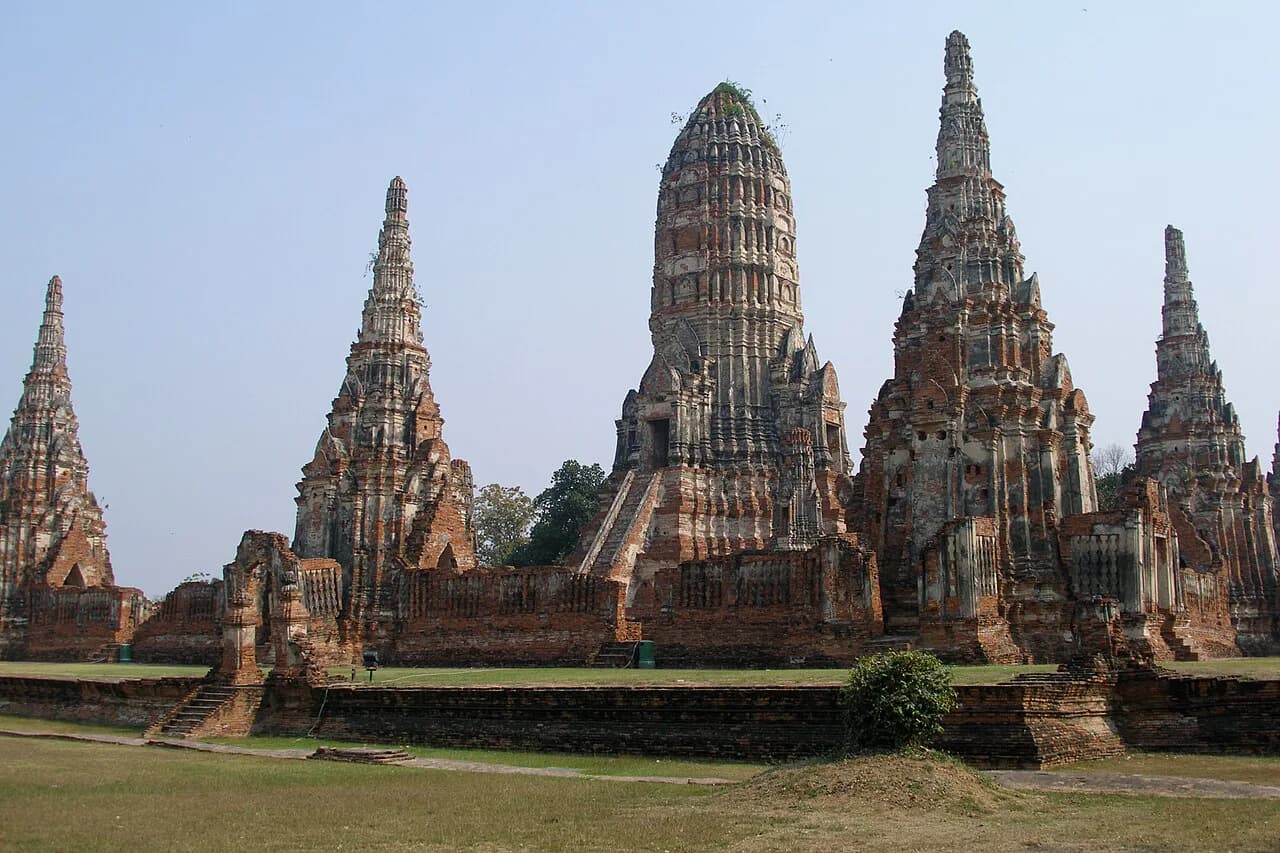
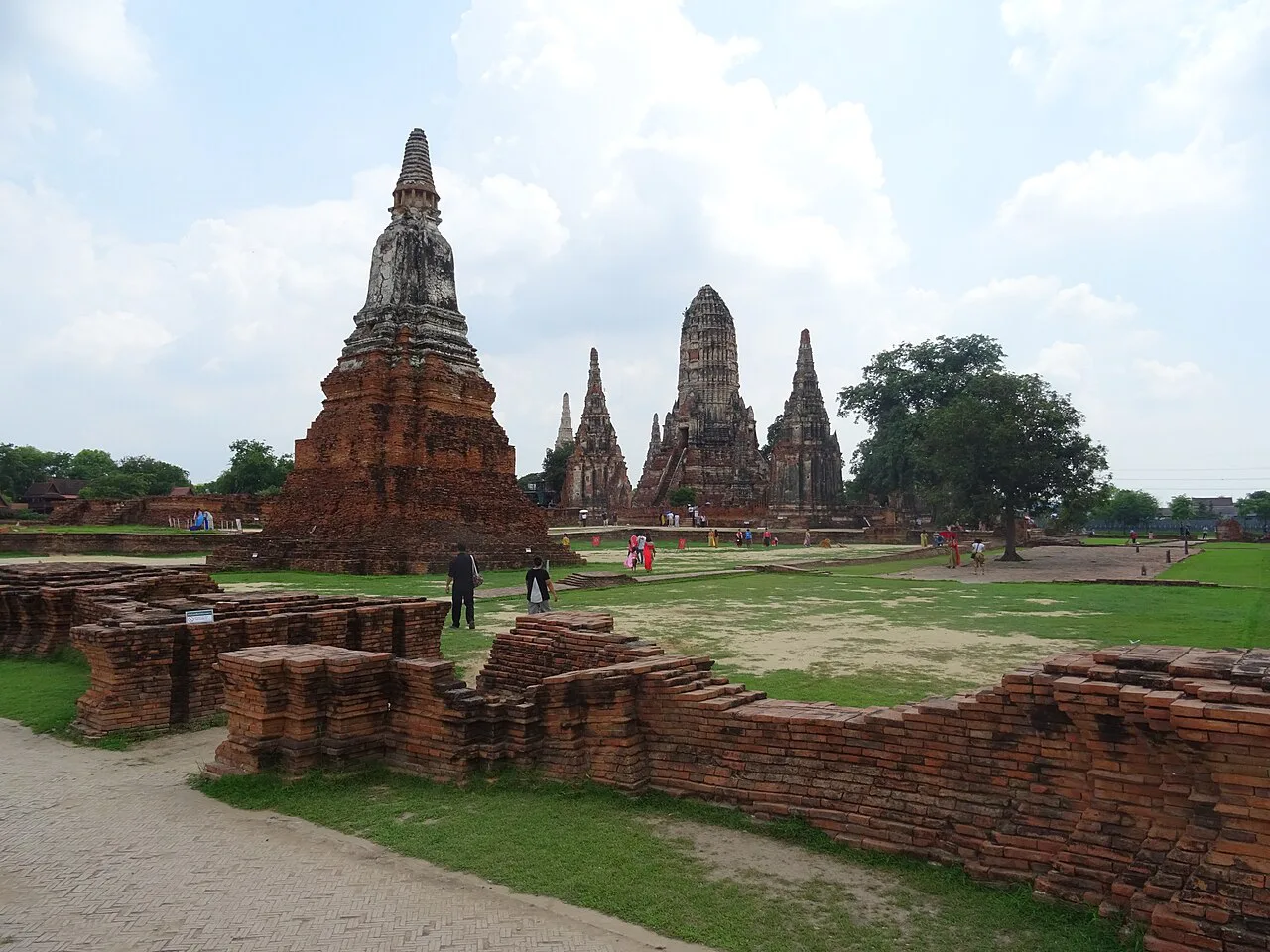
Treat the layout as the reason to come. A tall central prang stands ringed by four smaller towers and eight chapel chedi, all inside the trace of an outer wall, which makes the site read as a designed mandala rather than scattered fragments. Knowing that geometry in advance is the difference between wandering and actually seeing it.
What Wat Chaiwatthanaram is
Wat Chaiwatthanaram is a restored Buddhist temple ruin on the west bank of the Chao Phraya, opposite Ayutthaya Island and inside the boundaries of Ayutthaya Historical Park. It was inscribed with the park as a UNESCO World Heritage Site in 1991, and it ranks among the most photographed monuments in the former capital.
The complex is commonly dated to the reign of King Prasat Thong, built across roughly two decades in the mid-seventeenth century and dedicated to the memory of his foster mother, according to one widely cited account. Its centerpiece is a Khmer-style prang, the tower form borrowed from Cambodian temple architecture and popular in that era.
The temple was destroyed in the Burmese sack of 1767 and then abandoned for more than two centuries, stripped over time for bricks and artifacts. The Royal Thai government restored it in 1992, and the site was damaged again during Ayutthaya's late-2011 floods. Treat any account of its condition as a snapshot: ruins and access change, so confirm the current state before you build a day around it.
Where it sits: the west bank, not the island
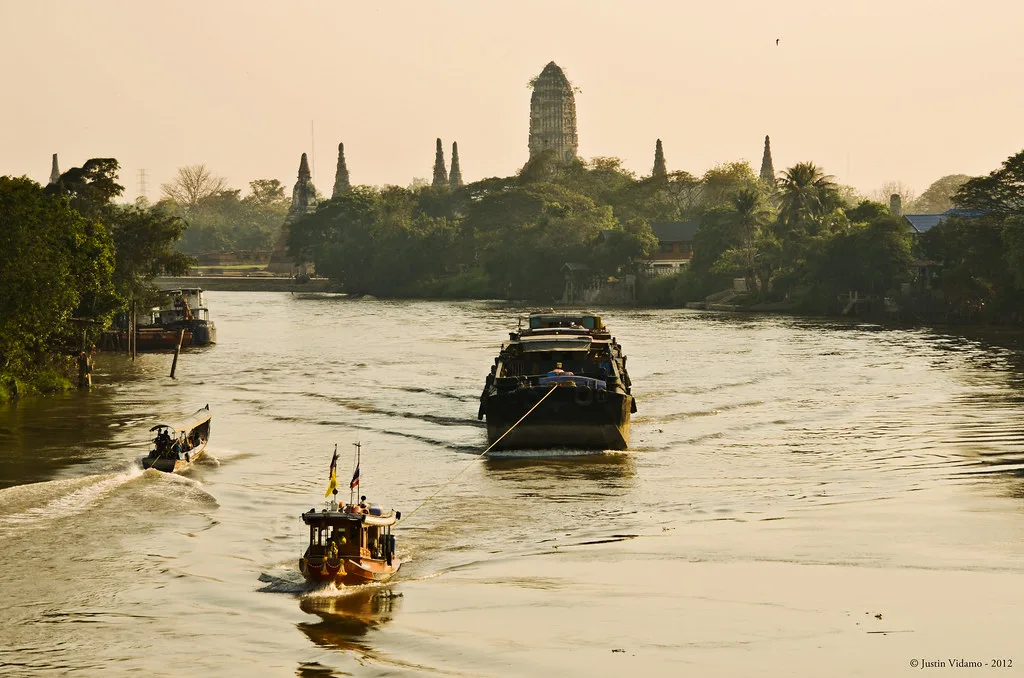
This is the geography that catches people out. Ayutthaya's best-known ruins cluster on the island formed by the Chao Phraya and its surrounding waterways, but Wat Chaiwatthanaram lies across the water on the western shore, with the river physically between it and the main group.
That single fact reshapes your sequencing. You cannot drift from the central ruins to this temple on foot without a crossing, so plan it as its own leg of the day rather than an afterthought tacked onto a walking circuit. The reward is a riverside setting the island temples do not have, with the prang silhouetted against open water and sky.
Think of the wider park as two zones: the dense concentration of ruins within the island ring, and the west-bank monuments including this one and the large chedi at Wat Phu Khao Thong further north. Grouping by zone saves you repeated crossings.

How to get there from Ayutthaya Island
Two practical options exist: cross by road bridge and approach by vehicle, or take a river ferry across and continue on the far side. From the guesthouse zone on the island, travelers typically use a tuk-tuk, a songthaew, a ride-hailing app such as Grab, or a rented bicycle, with the bridge route being the simplest for anyone without local knowledge.
River crossings are short and frequent in principle, but schedules and fares shift with season and operator, so ask at your guesthouse or at the pier on the day rather than relying on a printed timetable. Carry small notes in baht for the crossing and any onward ride.
If you are cycling, the bridge adds distance and traffic exposure compared with the quiet lanes inside the island ring, so weigh that against the freedom of arriving on your own schedule. A driver who waits while you visit is the least flexible option but removes all the logistics.
Touring the wider park by bicycle is one of the standard things to do in Ayutthaya, and this temple makes a natural far anchor for a loop. The Ayutthaya Attractions: 12 Visitor Guides collection covers how the other monuments fit around it.
What you see inside the walls
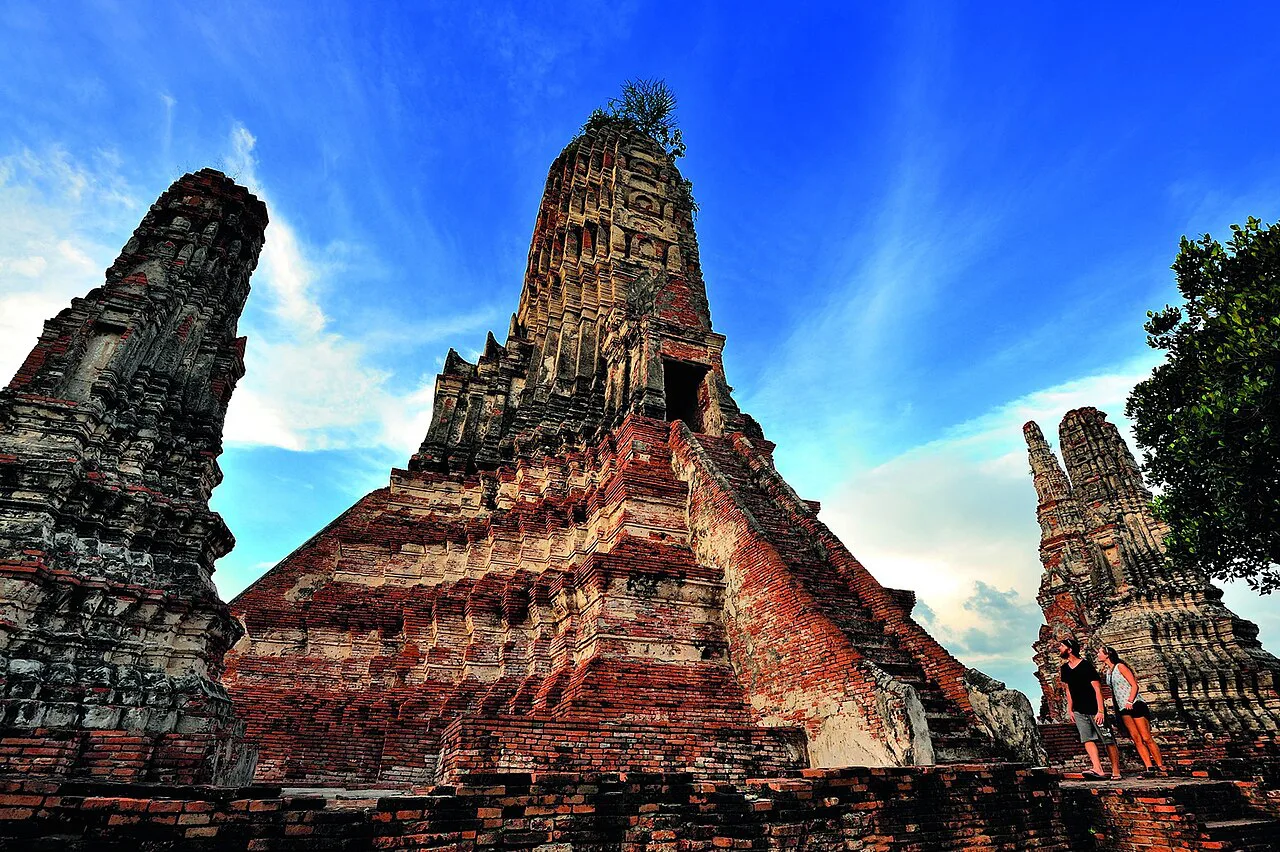
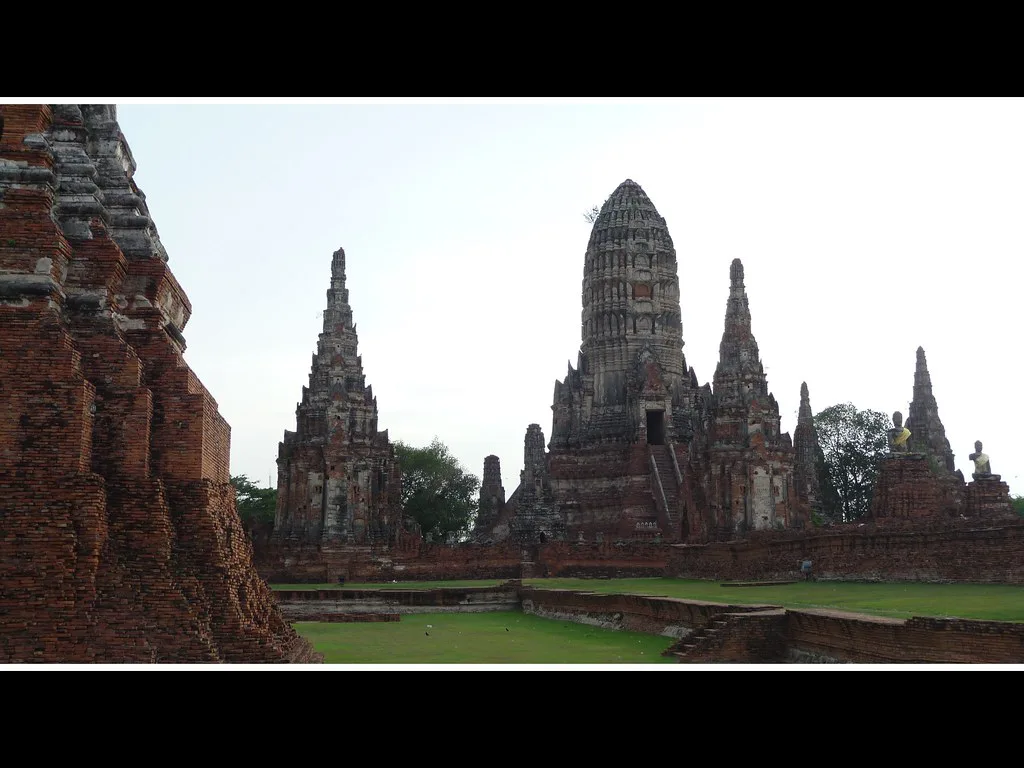
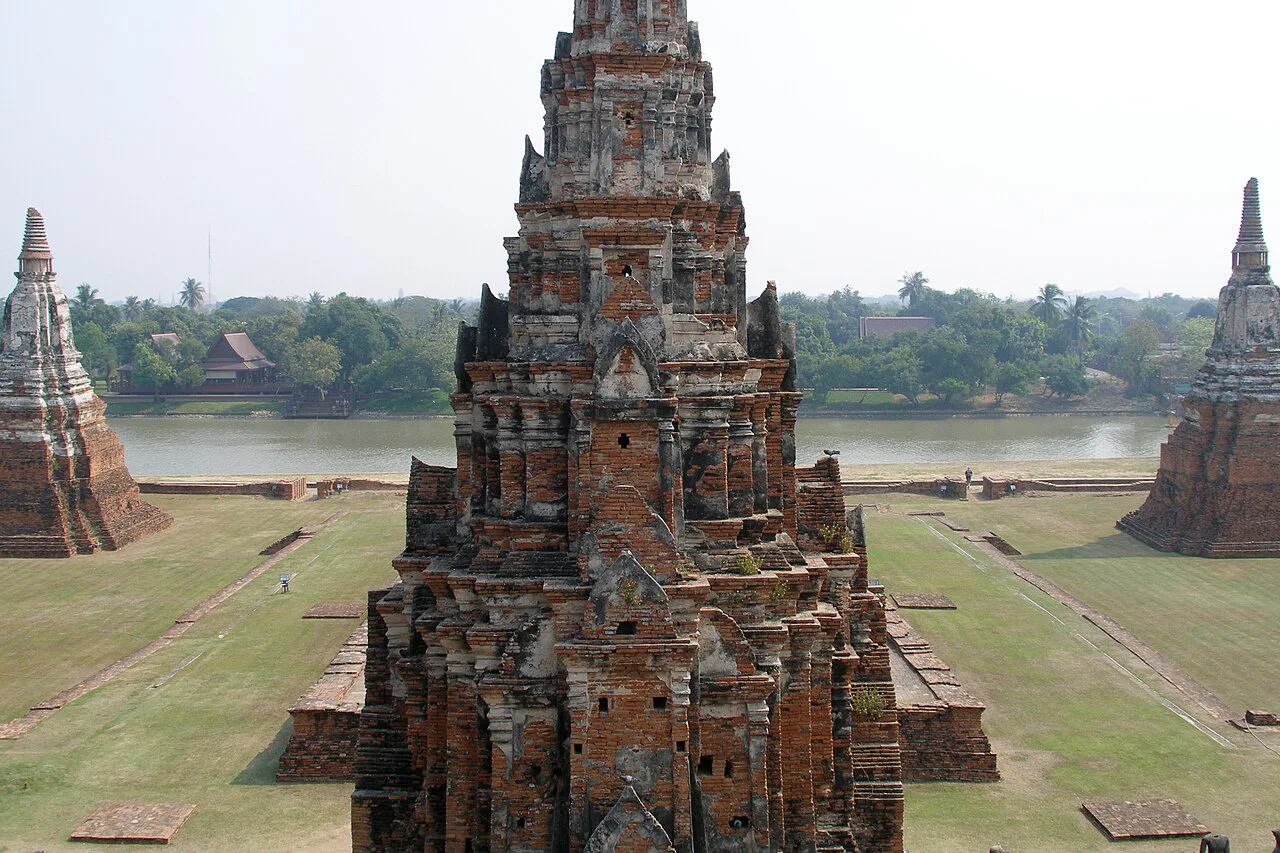
The centerpiece is the main prang, commonly described as roughly 35 meters tall by one account and about 34 meters by another, standing on a stepped base with stairways that once led to an ordination hall and a gallery. Treat the height as approximate rather than surveying it yourself.
Around that center sit four smaller prangs on the cardinal axes and eight chedi chapels arranged around the courtyard, several of them restored. The outer wall and gate foundations survive mainly as traces in the ground, which is why the site can look formless at first glance until you notice the symmetry.
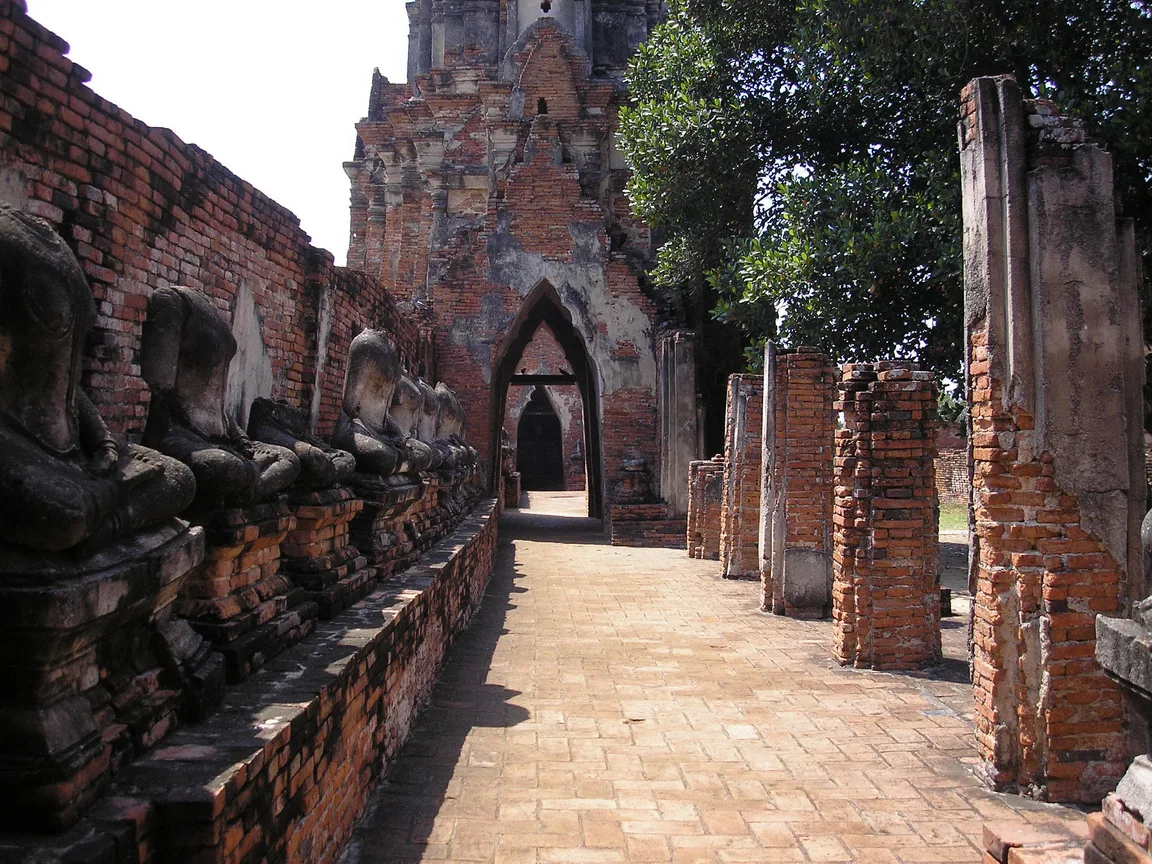
Near the river edge, two restored Thai-style chedi are said to have interred the ashes of King Prasat Thong's mother, and the remains of a royal boat landing once stood at the waterline. Statues at the site are largely damaged or headless, a common sight across Ayutthaya's ruins, and visitors regularly describe the effect as quietly haunting rather than grand.
Allow yourself to walk the courtyard perimeter first and then approach the center, because the plan only resolves from the outside in. Many visitors bring or rent traditional Thai dress for photographs here, a common sight rather than a requirement.
How the layout works and how to walk it
The design encodes Buddhist cosmology. The central prang stands for Mount Meru, the four smaller towers represent continents pointing outward, the courtyard ring stands for the encircling oceans, and the gallery and walls symbolize mountain ranges and the crystal walls of the world.
In practice, that means you should walk the ring first to register the square with its indented corners, then cross the courtyard to the central base, and finish at the riverside edge where the landing once stood. Each stage gives you a different reading of the same brick, and the sequence takes perhaps forty minutes without a guide.
Late-afternoon light is so often recommended here that it has become a widely reported visitor tip rather than an official rule, so arrive with an hour of daylight in hand rather than cutting it fine.

How long to allow, and how to pair it
Budget around an hour on site, plus travel each way across the water. That makes it a half-day anchor rather than a quick stop, especially if you combine it with the large chedi at Wat Phu Khao Thong to the north on the same bank.
The honest trade-off is this: adding it to a tight island temple loop means paying for the crossing twice in time and money and seeing it in flat midday light. Giving it its own late-afternoon slot costs you the chance to see every island ruin, but you get the site at its best and without hurrying.
If you only have one day in the city, see the island's signature monuments first, including the famous Buddha head at Wat Mahathat, Ayutthaya and the royal temple platforms of Wat Phra Si Sanphet, then decide whether the crossing still fits.

Tickets, hours and checking before you go
Hours, admission charges and any site notices are set by the Ayutthaya Historical Park and Thailand's Fine Arts Department, so check with the park office (or the Tourism Authority of Thailand attraction listing for Wat Chaiwatthanaram) for the day you plan to visit. Either beats a blog post written years ago.
Do not assume the site is open simply because the park is. Past flood damage and restoration work have closed it before, and repair programs on individual monuments can restrict access to parts of the complex without shutting the whole site.
Pay admission at the official counter if one is operating, and keep the ticket, since combined or park-wide arrangements vary over time. If a tout at the pier offers a package including the crossing and entry, compare it with the official price before agreeing.

Nearby monuments worth adding
On the same west bank, Wat Phu Khao Thong is known for its tall white chedi and is the obvious partner for this temple. Wat Na Phra Men, near the Tha Wasukri crossing point, is another option on the northern edge of the island if you are circling back by road.
Back on the island, Wat Ratchaburana, Wat Phra Ram and Wat Thammikarat sit within easy cycling distance of each other in the central cluster, and Wat Yai Chai Mongkhon lies east of the ring. The Chao Sam Phraya National Museum and the Ayutthaya Historical Study Centre are the places to make sense of the sculpture and artifacts removed from these sites.
If you want a break between ruins, the reclining Buddha at Wat Lokayasutharam near Pratu Chai is an open-air stop that takes only minutes, and Wat Phanan Choeng across the water southeast of the island draws worshippers for its large seated image.
Should Wat Chaiwatthanaram get its own slot?
Yes, if you can give it a late-afternoon window and an unhurried hour. The crossing is the cost, and the symmetry, the riverside setting and the quieter atmosphere are what you get for it, which is exactly what a rushed island loop cannot deliver.
If your day is already full, skip it without guilt rather than squeezing it into midday, and put the island's core monuments first. Either way, confirm hours and admission through the Tourism Authority of Thailand and the park office before you set out.
Explore more Ayutthaya guides
Frequently Asked Questions
Do you need a guide at Wat Chaiwatthanaram?
No. The complex is compact and its layout follows a clear pattern of a central prang, four smaller towers and eight chapel chedi around a courtyard, so you can read it yourself in about an hour. A guide adds context on the cosmology behind the plan and the temple's royal history, but it is not necessary to understand what you are looking at.
Sources
- Today I visited Wat Chaiwatthanaram in Ayuttaya, wearing traditional Thai clothing and walking through one of Thailand's most historic temples. Seeing the ancient ruins and the headless Buddha statues was a quiet reminder of how time, history, and culture are deeply connected. A peaceful and meaning
- Wat Chaiwatthanaram in Ayutthaya, Thailand
- Wat Chaiwatthanaram, Ayutthaya