
Kanchanaburi War Cemetery (Don Rak): A Visitor's Guide

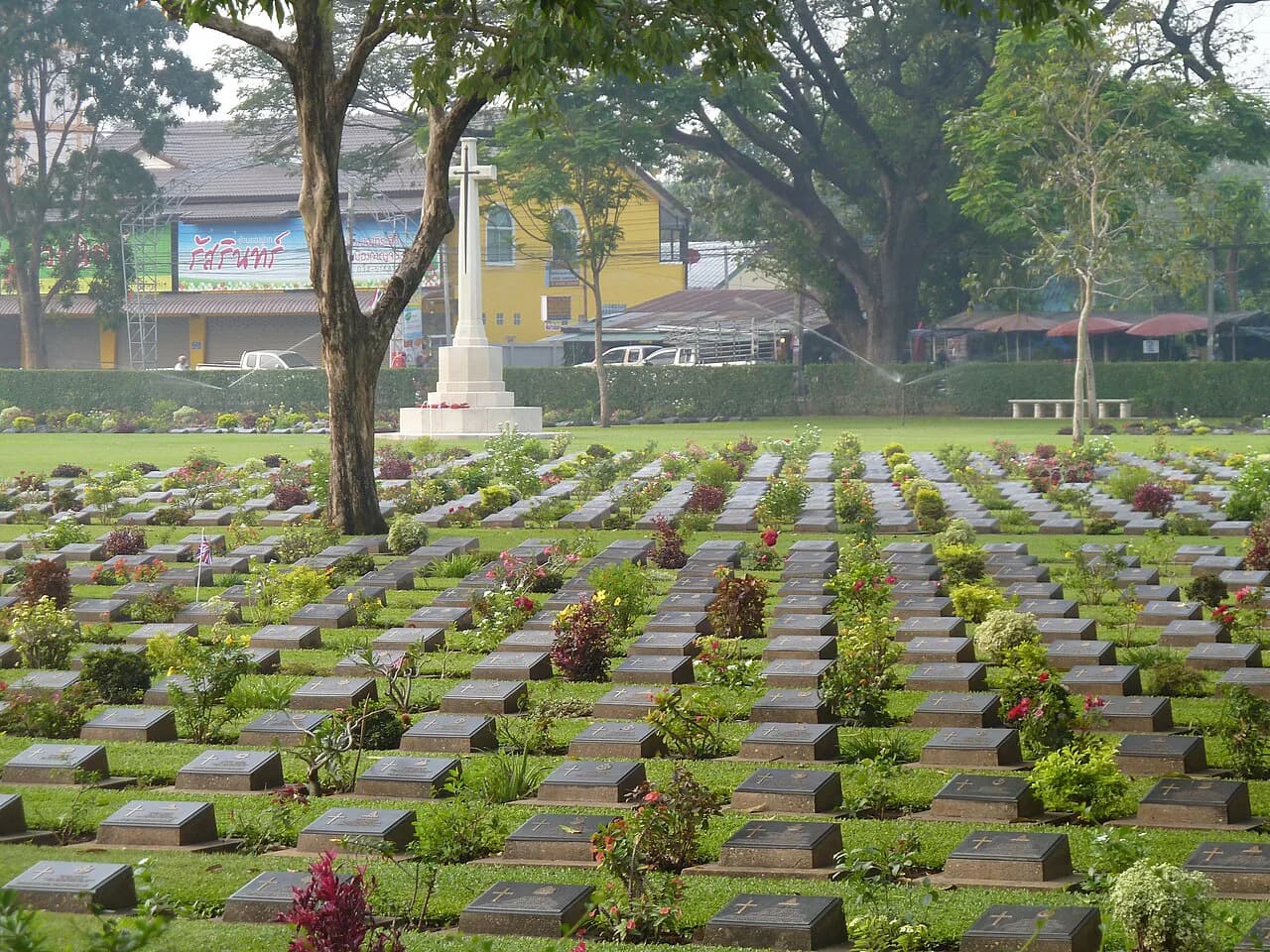
Kanchanaburi War Cemetery needs about 30 to 45 minutes: it is a small, flat, orderly site on the main road through town, not a museum you work through room by room. Most visitors come to walk the rows, read a few headstones and the memorial panels at the entrance, and leave with a clearer sense of the Burma-Siam Railway than any exhibit gives them. This guide covers where the cemetery sits, how to reach it from Bangkok and from central Kanchanaburi, what is actually inside, and how to pace a short visit.
The cemetery is maintained by the Commonwealth War Graves Commission and is known locally as Don Rak. Because it is a working cemetery rather than a ticketed attraction, the practical questions are orientation and timing rather than queues and ticket counters.
What the cemetery is and who is buried there
Some 7,000 prisoners of war are buried or commemorated here, the great majority British, Australian and Dutch, alongside other Commonwealth servicemen who died building the railway between Thailand and Burma during the Second World War. The Commonwealth War Graves Commission records 5,085 Commonwealth casualties buried or commemorated, 1,896 Dutch war graves and one non-war grave. Those figures are the ones to hold in your head rather than a single round total, because different sources count the site differently.
The site is the main prisoner-of-war cemetery for victims of the railway project, and it was designed by Colin St Clair Oakes. Graves were brought in after the war from camp burial grounds and isolated sites along the southern section of the line, which is why the cemetery reads as a consolidated record of the railway rather than the cemetery of a single camp. American remains were repatriated, so you will not find US graves among the rows.
One local operator's page puts the site at roughly 6,982 graves across about 27,200 square meters, with 6,858 identified. Treat that as a secondary figure that broadly matches the Commission's breakdown rather than a competing official count.
Where it sits on Saeng Chuto Road
The cemetery fronts Saeng Chuto Road, the main road running through Kanchanaburi town, in the Ban Tai area of Mueang Kanchanaburi District. If you are arriving from Bangkok, it appears on the left side of the road toward the northern end of town, with a Commonwealth War Graves Commission sign facing it from the opposite side. That signpost is the easiest landmark to watch for if you are riding a bus or songthaew and do not want to rely on a driver's idea of where to stop.
Because it sits on the town's main artery rather than down a side lane, the cemetery is easy to fold into a day that also includes the river and the museums. Kanchanaburi as a whole is about 129 kilometers northwest of Bangkok, reached by road on the highway running north from the capital, with bus and train services from Bangkok as well.
Getting there from Bangkok and from town
From Bangkok, the usual pattern is a bus or train to Kanchanaburi town, then a short ride along Saeng Chuto Road to the cemetery gate. The train is the more atmospheric option and the bus the more flexible one, but schedules and fares shift, so check them with the operator or at the station on the day rather than planning around a number you read online.
Once in town, the cemetery is close enough to reach by taxi, motorcycle taxi, bicycle or on foot from the central guesthouse strip. If you are already exploring the riverfront, a Grab or a tuk-tuk drop-off at the Saeng Chuto Road entrance is straightforward, and you can walk back into town afterward.
For a wider look at how the town's sights fit together, the Kanchanaburi Attractions: 11 Visitor Guides hub maps the river-side cluster, the museums and the out-of-town temples.
What you'll see inside: rows, panels and the entrance building
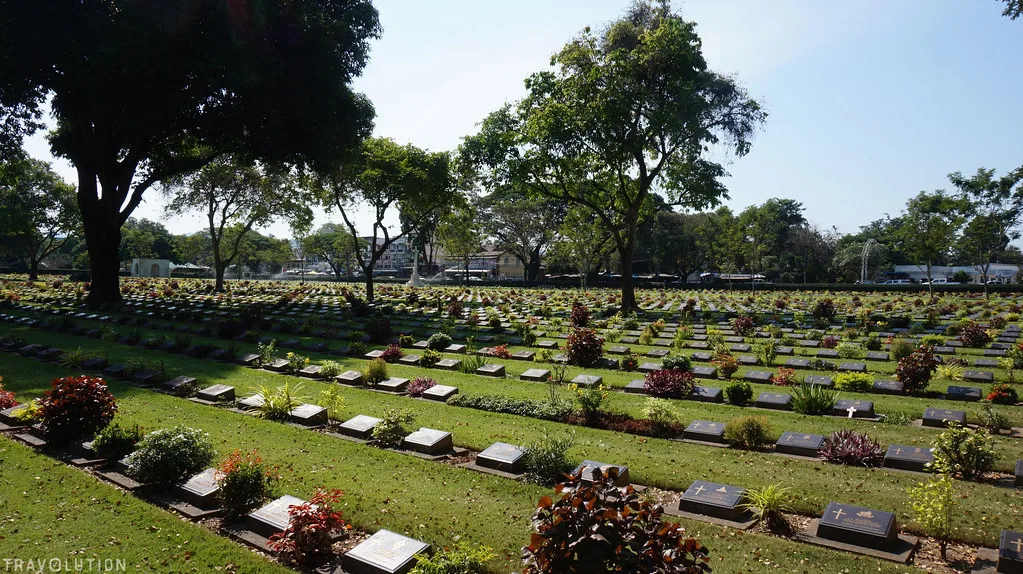
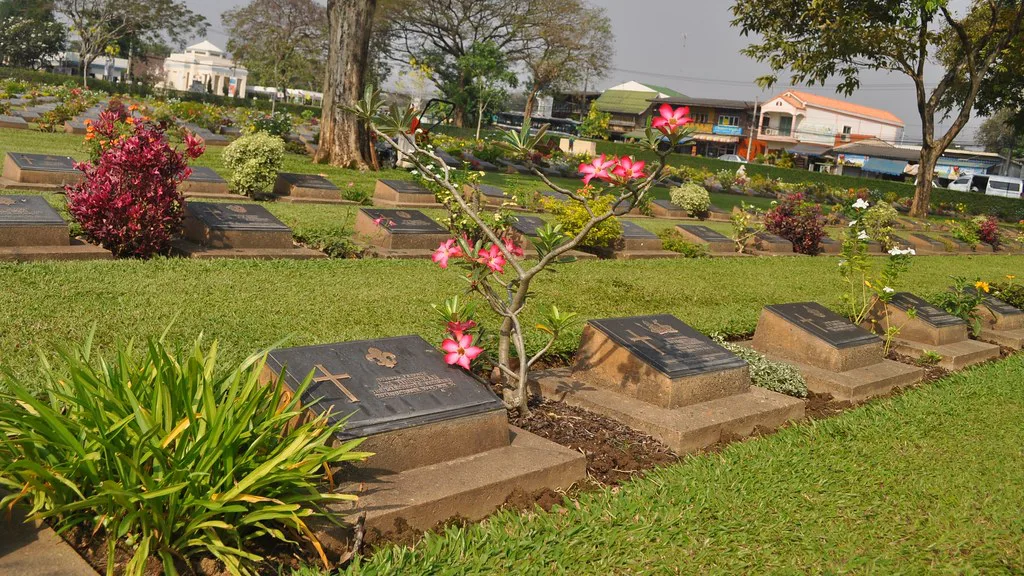
Inside, the layout is formal and almost military: straight rows of evenly spaced headstones on level, turfed ground, with the British graves largely to one side and the Australians and others to the other. The tidiness is the point, and it makes the scale of the loss legible in a way a list of figures does not. Walk a couple of rows slowly rather than trying to read every stone.
The entrance building holds the Kanchanaburi Memorial, which records the names of 11 men of the army of undivided India who were buried in Muslim cemeteries in Thailand where their graves could not be maintained. Look for this before or after walking the rows; it is the part of the site most visitors miss, and it explains why the cemetery commemorates some names without a grave beneath them.
Also look for the two graves holding the ashes of around 300 men who died at Nieke camp, most of them in a cholera outbreak in May and June 1943; their names are inscribed on panels in the shelter pavilion. It is a small detail with a large story behind it, and it rewards a few minutes of attention.
How long to allow, and pacing a visit in the heat
Budget 30 to 45 minutes if you want to walk the main rows, find the memorial panels and sit for a moment; an hour covers a slower read of individual headstones and the register. The site is compact and level, so the limit is the sun rather than distance, and there is little shade among the stones.
Go early or late in the day if you can. Kanchanaburi heat builds through the late morning, and the open lawn offers no cover once you are out among the rows; a hat and water carried in from town make the difference between a thoughtful visit and a hurried one.
Opening hours and entry: what to confirm
Sources disagree on hours, which is a good reason to confirm before you go. One travel account gives 08:00 to 17:00 Monday to Friday and 08:00 to 12:00 Saturday, while a local operator's page lists daily hours of 08:00 to 18:00, and another source describes the cemetery as open at all times. Check the Commonwealth War Graves Commission's cemetery page for current visiting arrangements rather than trusting a fixed number from a blog.
There is no ticket counter to buy from: one local operator's page states there is no admission fee, and the cemetery functions as an open memorial ground rather than a gated attraction. Do not budget for entry, but do plan your timing around daylight and the heat, and confirm current visiting arrangements with the Commonwealth War Graves Commission before you set out.
One more practical note from the site's own description: visitors are asked to watch for snakes in the cemetery. Stay on the paths and mown areas, and keep an eye on children who wander.
Nearby: the bridge, the museums and the river
The Bridge Over the River Kwai, Kanchanaburi is a short ride from the cemetery and the natural next stop for most visitors; the bridge and the cemetery together give you the physical railway and the human cost of it. Both sit within the same compact town stretch, so pairing them costs little extra time.
For context before or after, the JEATH War Museum in Kanchanaburi and the Thailand-Burma Railway Centre both cover the railway's construction, though they take contrasting approaches and neither replaces walking the graves. The railway centre is the more archive-driven of the two, while JEATH is the older, rougher collection.
If you are comparing memorial sites, Chungkai War Cemetery lies on the other side of town and holds the graves from the Chungkai camp area, so the two cemeteries together tell the fuller story of where the dead were originally buried.
How to behave in a working cemetery
This is an active memorial ground with staff tending the grass and headstones, not a photo set. Keep your voice low, avoid walking across grave plots to shortcut between rows, and ask before photographing any visitors who are clearly there to find a relative.
Families still travel here to locate names, and the Commonwealth War Graves Commission's burial records are the tool they use; search those records for a plot reference before you go and leave any on-site materials as you found them. To understand the Commission's record-keeping, its own page on the cemetery is the place to start rather than a commercial tour description.
Is the cemetery worth stopping for?
Yes, if you are already in Kanchanaburi for the railway sights. It is central and short, and it grounds the bridge and museum visits in something concrete. If your only reason for coming to town is the bridge, tack the cemetery onto the same half-day rather than making a separate trip.
Go in the morning or late afternoon, allow half an hour to an hour, watch for the sign on the opposite side of Saeng Chuto Road, and confirm the day's hours with the Commonwealth War Graves Commission before you set out. Then walk the rows slowly, find the Indian army names at the entrance, and give the Nieke ashes their moment.
Explore more Kanchanaburi guides
Frequently Asked Questions
Is there an entrance fee for Kanchanaburi War Cemetery?
There is no ticket counter; one local operator's page describes the site as having no admission fee. Treat it as an open memorial ground maintained by the Commonwealth War Graves Commission, and check the Commission's page for current visitor arrangements before you go.
Can I find a specific grave or name at Don Rak?
The Commonwealth War Graves Commission maintains the burial records for the cemetery. Search the Commission's online records for a name before you travel, then use the plot reference on the ground; staff tending the grounds can usually point you in the right direction.
How do I get to Kanchanaburi War Cemetery without a car?
Take a bus or train from Bangkok to Kanchanaburi town, then a taxi, motorcycle taxi or tuk-tuk along Saeng Chuto Road to the cemetery entrance. From the central guesthouse area it is also walkable or a short bicycle ride, and the site fronts the main road rather than a side lane.
What should I look for beyond the headstones?
The Kanchanaburi Memorial in the entrance building records 11 men of the army of undivided India, and the shelter pavilion panels carry the names of men who died at Nieke camp whose ashes lie in two graves. Both are easy to miss if you only walk the main rows.