
Sukhothai Historical Park: How the Zones Work and How Long to Allow

Plan on a half day for the inner walled zone and a full day if you want all three ticketed areas. Sukhothai Historical Park spreads across the old city of Mueang Kao in Sukhothai Province, and its monuments are grouped into an inner historic zone, a northern zone around Wat Si Chum and Wat Phra Phai Luang, and a western Aranyik area. This guide explains how each zone is priced and timed, what to see in each, how to move between them, and how much of a day to budget.
What Sukhothai Historical Park is and where it sits
The park protects the ruins of Sukhothai, an early capital of the Thai kingdom, and was declared a UNESCO World Heritage Site in 1991. It covers roughly 70 square kilometers and holds dozens of temples, chedis and Buddha images built between the 13th and 15th centuries. The core is the walled old city at Tambon Mueang Kao, Amphoe Mueang, Sukhothai Province, the address the park office publishes, with New Sukhothai serving as the modern town where most transport and hotels cluster.
Because the old city and New Sukhothai are separate places, decide early whether you will stay near the ruins or in town. Staying in Mueang Kao puts you within walking or cycling distance of the gates; staying in New Sukhothai means a short daily transfer. Neither choice is wrong, but it changes how early you can reach the inner zone before the heat builds.
The three ticketed zones explained
The park's unusual feature is that admission is charged by area, not by one all-park ticket. The official map lists three zones with separate fees: the inner historic zone, the northern external zone containing Wat Si Chum and Wat Phra Phai Luang, and the western external zone known as Aranyik. Foreign visitors pay one rate per zone, and a flat-rate option covers all three. Knowing this matters because a ticket for the inner zone alone will not get you into Wat Si Chum.
The inner zone is the walled city and holds the densest cluster of monuments, including Wat Mahathat, Wat Sa Si and Wat Si Sawai. The northern zone is quieter and more spread out, anchored by the huge seated Buddha at Wat Si Chum and the Khmer-style prangs at Wat Phra Phai Luang. The western Aranyik area is hillier and less visited, with Wat Saphan Hin as its best-known monument.
Opening hours and admission fees for each zone
The park's official page lists the inner historic zone as open daily from 6:30am to 7:30pm Monday through Friday and Sunday, with a later 9pm close on Saturday. The northern zone, containing Wat Si Chum and Wat Phra Phai Luang, runs 7:30am to 5:30pm, while the Aranyik area runs 8am to 4:30pm. The park office operates 8:30am to 4:30pm. Treat these as the published schedule and confirm on arrival if you are building a tight day around the northern or western zones.
Fees follow the same three-zone structure. The official page lists 200 THB for foreign visitors in the inner historic zone and 120 THB in the northern and western zones, or a 400 THB flat rate covering all three zones, with Thai nationals paying 20 THB per zone or 40 THB flat. Children, students with ID, people over 60 and clergy receive free entry under the listed conditions, and Thai visitors get free entry on specified annual holidays. Vehicles pay separately, from 10 THB for a bicycle up to 50 THB for a car in the northern and Aranyik areas.
If you only have time for the inner zone, the single-zone ticket is the cheaper choice. If you plan to reach Wat Si Chum and Wat Saphan Hin in the same day, the flat rate usually wins. Bicycle rental is a separate cost paid to the rental shop, so ask before you ride off rather than assuming it is bundled with admission.
How to get there and move between zones
Most travelers reach the park from New Sukhothai by songthaew, tuk-tuk or a booked car, and the ride ends at the main gate on the east side of the walled city. From there the inner zone is walkable, but the northern and western zones sit outside the walls and are too far to cover comfortably on foot in the heat. A bicycle turns the three zones into a manageable loop, and rental shops cluster near the gate.
Bangkok Airways' guide notes that bicycle rental typically runs somewhere between 10 and 50 baht per day, depending on the shop, and recommends cycling as an easy way to cover the grounds. Confirm the price and whether a deposit is required when you rent. If you hire a car or tuk-tuk for the day instead, agree on the zone order up front, since the northern and western zones close earlier than the inner zone.
What to see inside the inner zone
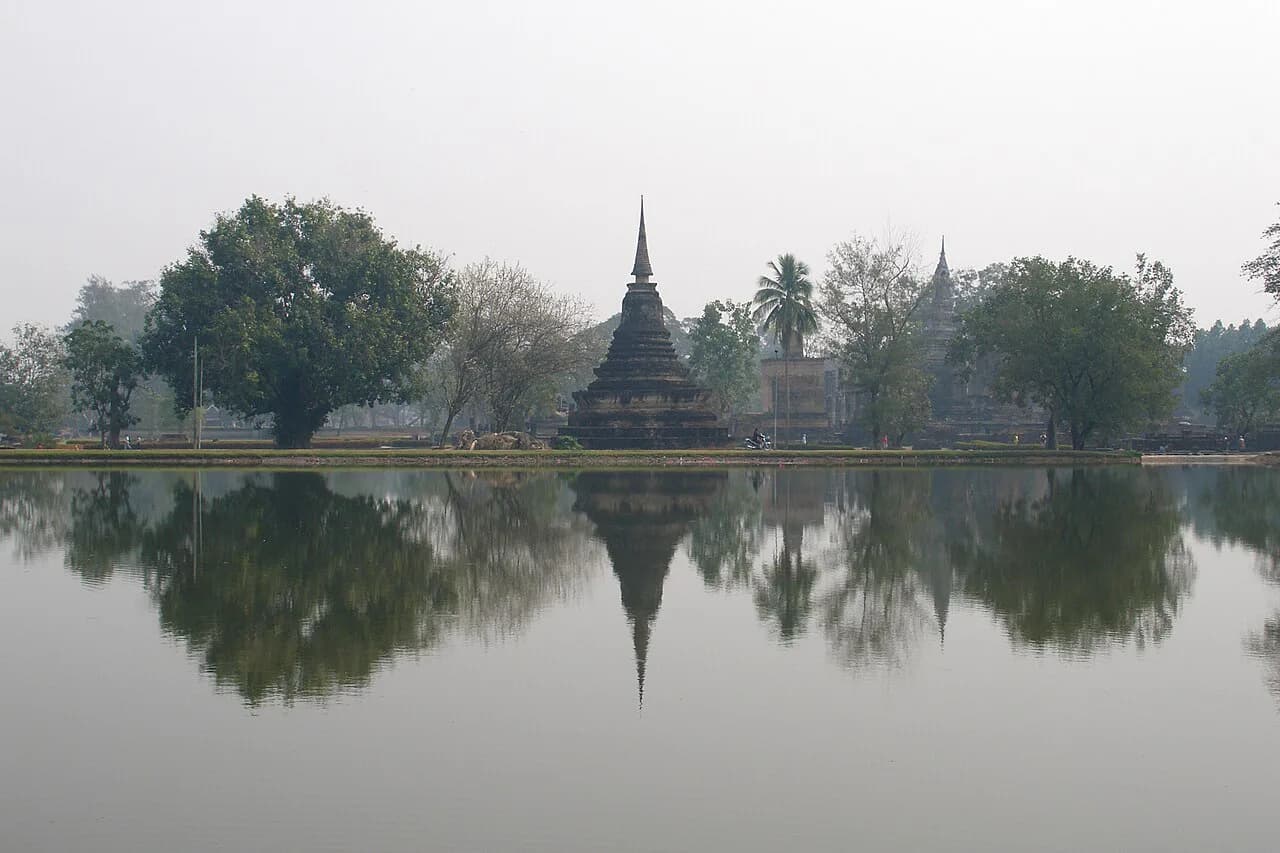
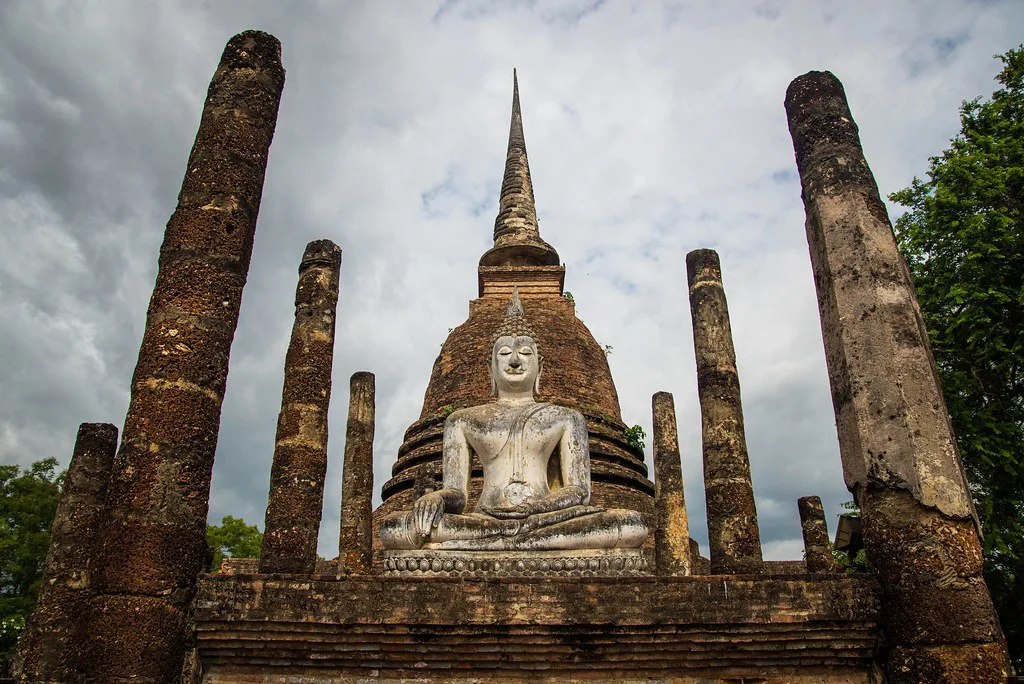
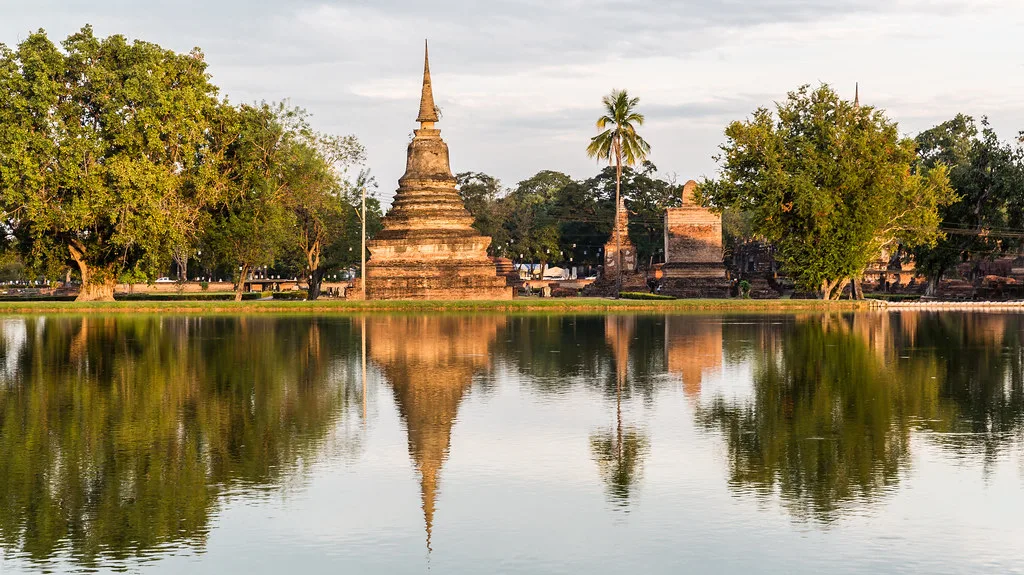
Wat Mahathat is the centerpiece, a large complex of chedis and columned halls that once formed the spiritual heart of the city. Nearby, Wat Sa Si sits on an island in a small reservoir, reached by a short causeway, and Wat Si Sawai is recognizable by its three Khmer-style prangs. All three are within easy walking distance of each other inside the walls, so this is where a first visit naturally begins.
Allow at least two hours to walk the core loop of Wat Mahathat, Wat Sa Si and Wat Si Sawai without rushing. The Ramkhamhaeng National Museum sits just outside the main gate and has its own separate admission, so budget extra time and money if you want to see its collection of Sukhothai-period art. Many visitors pair the museum with the ruins on the same morning.
The northern zone: Wat Si Chum and Wat Phra Phai Luang
Wat Si Chum is the northern zone's draw, a roofless mondop enclosing a huge seated Buddha known as Phra Achana, roughly 15 meters high and 11 meters wide. Devotees often add gold leaf to the Buddha's right hand, a mark of the image's standing with local worshippers. Give this one 30 to 45 minutes, since its scale rewards slow looking rather than a quick photo stop.
Wat Phra Phai Luang, a short ride away, predates the Sukhothai kingdom and shows clear Khmer influence in its three prangs. It is surrounded by a wide moat and sees far fewer visitors than the inner zone, which makes it a good place to slow down. Because the northern zone closes at 5:30pm, visit it before returning to the inner zone for late afternoon light.
The western Aranyik area and Wat Saphan Hin
The Aranyik area sits west of the walls and is the least visited of the three zones, with a hilltop setting that requires a short climb. Wat Saphan Hin is its signature monument, marked by a standing Buddha that looks out over the plain. The zone's 8am to 4:30pm hours mean it should come earlier in the day, not after the inner zone at sunset.
Cyclists should note that the ride west is more exposed and less shaded than the inner zone loop, so carry water. If you are short on time, this is the zone to skip: the inner and northern areas deliver the park's headline monuments, while Aranyik rewards those with an extra hour and a willingness to climb.
How much time to allow
A half day of roughly three to four hours covers the inner zone comfortably, including the museum if you move briskly. A full day of six to seven hours lets you add the northern zone and, for strong cyclists, the western Aranyik area. The constraint is not distance so much as the zone closing times: the northern and western areas shut well before the inner zone, so front-load them.
If you arrive from New Sukhothai in the morning, aim to be at the gate close to opening so you can reach Wat Si Chum before the heat peaks. Travelers staying in Mueang Kao have an easier time splitting the visit into a morning and a late-afternoon session. Either way, build in a mid-day break rather than treating the park as a single continuous push.
What's nearby around the old city
Tha Nam Rab Sadet Market sits near the old city and is a practical stop for food and supplies after a morning among the ruins. The King Ramkhamhaeng Monument is also close to the main gate, making it an easy addition on foot. Beyond these, the surrounding area is quiet, so plan your meals and water around what is open near the gate rather than expecting a dense restaurant strip.
For a broader sense of what else the town offers beyond the park, including routes and day plans, see this guide to things to do in Sukhothai. It helps if you are deciding whether to give the ruins one day or two.
Should you buy the single-zone or flat-rate ticket?
Buy the single inner-zone ticket if you have half a day, and the flat rate if you intend to reach Wat Si Chum and Wat Saphan Hin. The deciding factor is not the price difference but the closing times: the northern and western zones shut hours before the inner zone, so a late start effectively rules them out. Check the official park page before you go in case hours or fees have changed.
Explore more Sukhothai guides
Frequently Asked Questions
How big is Sukhothai Historical Park?
The park covers roughly 70 square kilometers, but the monuments you will actually visit cluster in the walled inner zone and two external areas. You do not need to cover the full area to see the highlights. Plan around the three ticketed zones rather than the total size.
When did the Sukhothai Kingdom start and end?
Sukhothai is usually dated from the 13th century, with the kingdom flourishing between the 13th and 15th centuries, when most of the park's monuments were built. It was later absorbed by Ayutthaya. The exact founding date is debated among historians, so treat any single year with caution.
Why was Sukhothai abandoned?
Sukhothai declined as Ayutthaya rose and the political center of gravity shifted south, leaving the old city largely deserted. The ruins were later reclaimed as a historical park and listed by UNESCO in 1991. The site's official materials focus on the monuments rather than a detailed account of the abandonment.