
Wat Si Sawai: The Khmer-Style Prangs Inside Sukhothai Historical Park

Wat Si Sawai deserves 30 to 60 minutes on a park circuit, and it earns that time for one reason: three tall, slender prangs that look nothing like the bell-shaped chedis around them. It sits just south of Wat Mahathat in the heart of the central zone, so you will almost certainly pass it whether or not you plan to. This guide covers its position, the architecture you are looking at, the Hindu-to-Buddhist conversion story, practical timing, and how to fit it into a half-day route.
Where Wat Si Sawai Sits Inside Sukhothai Historical Park
Wat Si Sawai stands in the central zone of Sukhothai Historical Park, in Mueang Kao subdistrict, roughly 350 meters south of Wat Mahathat and close to the old city's southern wall. That short gap matters: it places the temple between the park's biggest crowd magnet and the south gate, on a natural walking line rather than a detour. The address commonly listed is in Mueang Kao, Mueang Sukhothai District, Sukhothai 64210, which is the old walled city rather than the modern town center.
If you are orienting yourself by the park's main landmarks, think of Wat Si Sawai as the first interesting stop south of Wat Mahathat, ahead of the southern gate and the road that runs along it. The central zone is compact enough that a bicycle covers it in an easy loop, and this temple is one of the points where the loop naturally turns. For the wider layout of the walled city and how its zones fit together, start with the overview of Sukhothai Attractions before you commit a route to paper.

What You're Actually Looking At: Three Laterite and Brick Prangs
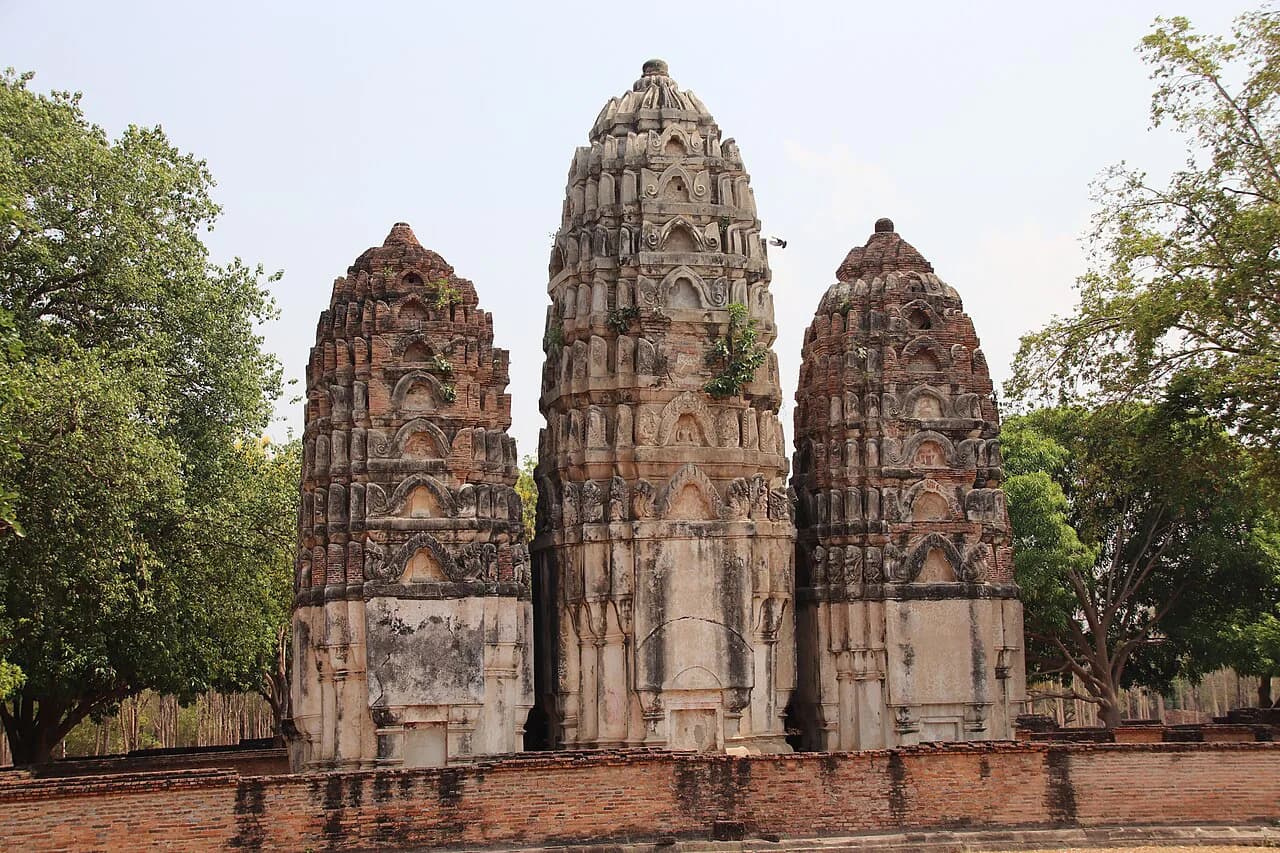
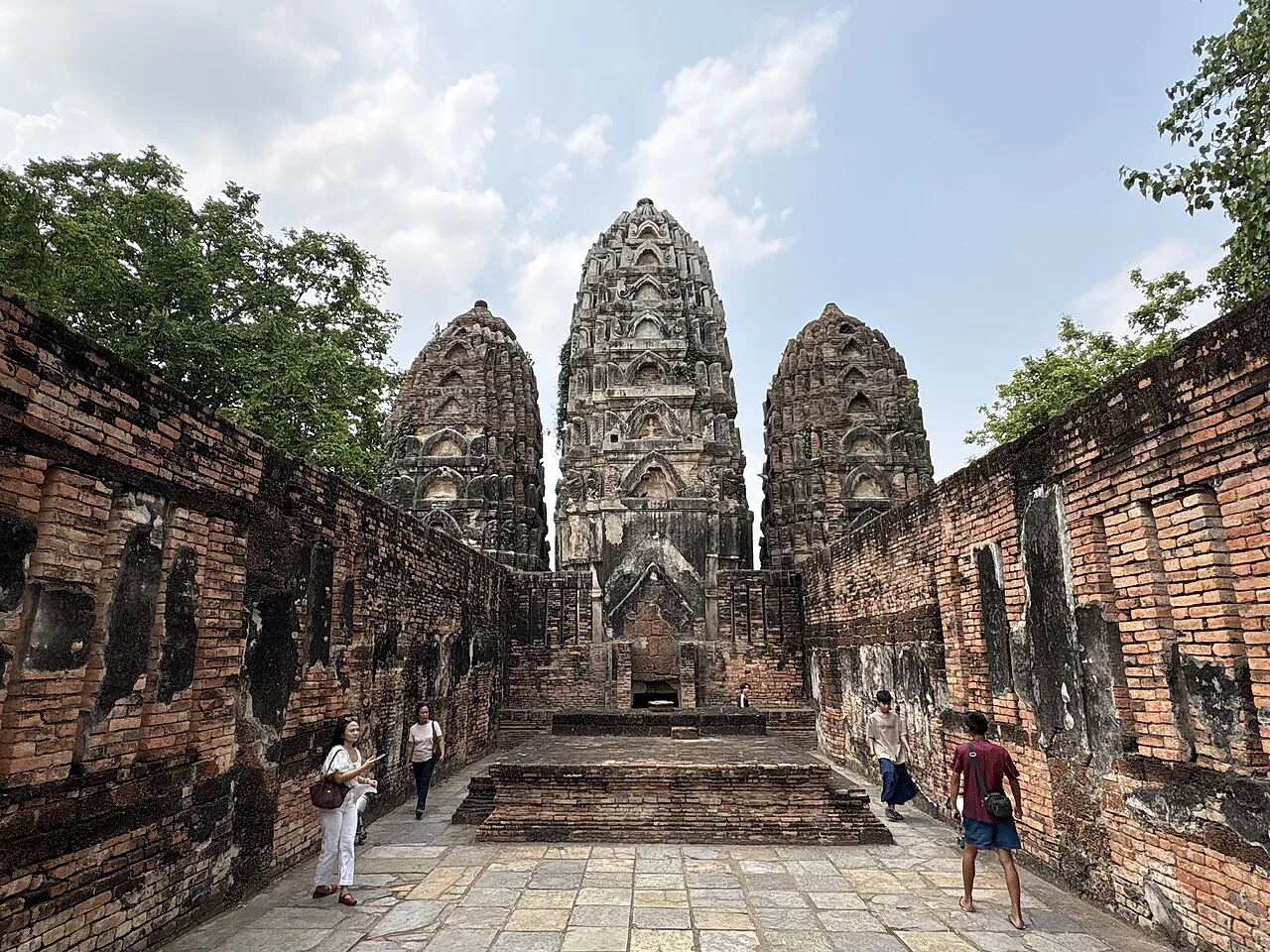
The defining feature is a row of three prangs built of laterite and brick, in the Lopburi style shaped by Khmer art. A prang is a tower-like shrine, taller and more slender than the bell-shaped chedis that dominate most Sukhothai temples, and these three sit on a low base rather than a massive one. Look at how little masonry supports the weight above it, and at the stucco ornament still clinging to the towers; some of the patterns have been compared to decoration found on Chinese Yuan pottery.
The base is ringed with reliefs of white elephants, a detail that rewards a slow walk around the plinth before you head for the towers themselves. Reading the site gets easier once you can separate a prang from a chedi, because the park's other famous monuments are almost all the latter. Wat Si Chum and its seated Buddha, for instance, is a different architectural idea entirely, which is exactly why the contrast is worth noticing.
The Hindu-to-Buddhist Story Behind the Towers
Most accounts trace Wat Si Sawai to Khmer influence in the 12th to 13th centuries, when it is thought to have served as a Hindu shrine, possibly dedicated to Shiva, before being converted into a Buddhist temple during the Sukhothai period. Dating this far back is debated among historians, so treat the century ranges as the working consensus rather than settled fact. The conversion is visible in the architecture: a chapel was added at the front, changing how the site was used.
The conversion case rests partly on a discovery in 1907, when King Rama VI, then crown prince of Siam, visited the site and found a statue of Phra Sayumphu, or Lord Shiva, in the chapel. Carved lintels at the temple include an image of Narayana reclining on the ocean, along with fragments of other idols, which reinforced the reading of an earlier Brahman-Hindu sanctuary. Those finds are the reason this temple looks so unlike its neighbors, and they are the story to carry away with you.

Layout on the Ground: Prangs, Chapels, Wall and Entrance
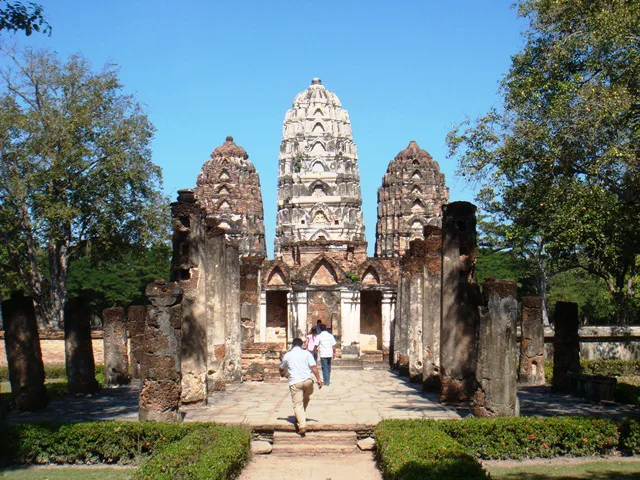
On the ground the plan is straightforward: the three prangs stand in a row at the center, with two connected chapels, or vihara, in front of them, and the whole compound is enclosed by a laterite wall. One Trip.com visitor post reports that the gate opens on the south side with a moat outside the wall, so approach from the south and use the marked entry rather than walking around the wall assuming an opening.
The grounds are heavily shaded by trees, which makes this a comfortable pause in the middle of a hot park circuit rather than a site to rush through. Walk the perimeter once to see the elephant reliefs and the wall, then approach the prangs from the front chapels so the row of towers reads as a group. On a bicycle loop, this is an easy place to park, spend twenty minutes, and roll on.
How to Get There: On Foot, by Bicycle, or by Car
From Wat Mahathat, the simplest approach is on foot: the 350-meter walk south takes a few minutes and delivers you to the southern entrance. Most visitors cover the central zone by rented bicycle, which turns Wat Si Sawai into a two-minute pedal from the main monument and makes the park loop practical in the heat. If you arrive by car, parking is available near the site according to Trip.com's listing, though the exact lot arrangement is worth confirming when you reach the park.
For a one-way walking figure, a short trail record lists the site as an easy 1.3 km route with minimal elevation gain, taking roughly half an hour to an hour if you walk it as a loop. That is a reasonable planning number for the stretch around the temple rather than the whole park. Riders and drivers should treat the old city roads as narrow and use designated parking rather than the roadside near the wall.
How Much Time to Allow
Budget about one to two hours if you plan to linger over the stucco details, read the lintel story, and walk the wall and moat, which is the sightseeing time Trip.com suggests for the temple. As a quick stop on a bicycle circuit, most travelers will spend far less, closer to 20 or 30 minutes, because the site is compact and the main features are all in one place. Decide which kind of visit you want before you arrive, since the park rewards a slow pace but punishes an overpacked schedule.
If your day only allows one deep stop in the central zone, spend it at Wat Mahathat or Wat Si Chum and treat Wat Si Sawai as a well-chosen 20-minute addition. The trade-off is real: the prangs are the most architecturally distinct thing in the central zone, but they are not the largest monument. Pairing this stop with a longer visit to Wat Si Chum, which lies outside the central zone and is best reached by bicycle or car, gives you both scale and style in one day.
Best Light and Fitting It Into a Half-Day Route
Early morning and late afternoon light are the most flattering on the prangs, when the low sun picks out the texture of the laterite and the remaining stucco. Midday is harsh and the brick surfaces flatten out, though the tree cover keeps the walking itself bearable. If photography matters, plan your circuit so this temple lands at one end of the day rather than in the middle.
A sensible half-day route runs from Wat Mahathat south to Wat Si Sawai, continues along the southern wall, and works back north through the central zone, leaving the northern monuments such as Wat Phra Phai Luang for a separate stretch. That order keeps you moving in one direction instead of crisscrossing the walled city. The broader list of Sukhothai Attractions is the place to build the rest of the sequence.
Tickets, Hours and the Day Pass: What to Check
Do not plan around a fixed opening time for Wat Si Sawai, because published figures conflict between sources and one listing explicitly advises contacting the attraction to confirm its hours. The temple sits inside the paid zone of the historical park, so the practical question is not a separate temple ticket but the park's own admission and day-pass rules, which change and should be confirmed at the ticket office or park entrance on the day you visit. Keep one reminder in mind: verify hours and ticket terms at the gate rather than trusting an old web listing.
Is Wat Si Sawai Worth the Stop?
Yes, as a short stop rather than a destination in its own right. The three Lopburi-style prangs give you something the rest of the central zone does not, and the Shiva discovery story turns three brick towers into a readable piece of Sukhothai's religious history. Build it into a bicycle circuit south of Wat Mahathat, allow 20 to 60 minutes depending on your pace, and confirm hours and park admission at the entrance before you set out.
Explore more Sukhothai guides
Frequently Asked Questions
Is Wat Si Sawai a Hindu or Buddhist temple?
It is generally understood as a Hindu shrine built under Khmer influence in the 12th to 13th centuries that was later converted into a Buddhist temple during the Sukhothai period. The reading rests partly on a Shiva statue found at the site in 1907 and on carved lintels, including one showing Narayana. Dating from this period is debated, so treat the century range as the working consensus.
How old is Wat Si Sawai?
Most accounts place its construction under Khmer influence in the 12th to 13th centuries, which would make it roughly contemporary with the early Sukhothai kingdom. Historians disagree on precise dates, so no single year is reliable. The architecture itself, particularly the three Lopburi-style prangs on a low base, is the clearest evidence of its age.
Do I need a separate ticket for Wat Si Sawai?
The temple sits inside Sukhothai Historical Park, so admission is handled through the park rather than at the temple itself. Park ticket prices and day-pass rules change, and they are not published in a stable form here, so check the terms at the ticket office or park entrance when you arrive. Do not budget from an old figure found online.
Are there other temples close to Wat Si Sawai?
Yes. Wat Mahathat is about 350 meters north, making it the nearest major monument, and the southern wall and gate are just beyond the temple's own moat. Wat Si Chum lies north of the old city and is best reached by bicycle or car rather than on foot from this spot.